US Supreme Court Strikes Down Trump Tariffs in 6–3 Ruling, $175 Billion Refunds at Stake


The US Supreme Court has issued a landmark 6-3 ruling striking down President Donald Trump’s sweeping global tariffs imposed under the International Emergency Economic Powers Act (IEEPA), ruling them illegal and an unlawful expansion of presidential authority. The decision, delivered on February 20, 2026, delivers a major blow to Trump’s trade strategy, which relied on emergency declarations to impose broad import duties on goods from virtually every trading partner.
Chief Justice John Roberts authored the majority opinion, joined by Justices Sotomayor, Kagan, Jackson, Gorsuch, and Barrett. The Court held that IEEPA—a 1977 statute designed to regulate commerce in response to national emergencies involving foreign threats—does not authorize the president to impose tariffs or duties, as the law contains no explicit reference to taxation powers. Dissenting were Justices Thomas, Alito, and Kavanaugh.
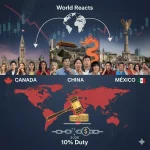
This invalidates key tariffs, including those proclaimed on “Liberation Day” and others targeting issues like drug flows or trade deficits (e.g., 25% on many imports from Canada and Mexico, 10%+ on Chinese goods, and broad levies affecting dozens of nations). Estimates from sources like Penn-Wharton and the Tax Foundation indicate over $160–175 billion (potentially up to $200 billion) in collected tariffs could now be subject to refund claims, though the ruling remands details—including refund processes—to lower courts like the Court of International Trade, without mandating immediate repayments.
President Trump responded sharply, denouncing the ruling as “terrible” and “deeply disappointing,” calling justices who joined the majority a “disgrace,” “fools,” or “lap dogs.” Within hours, he signed a new temporary 10% global tariff under Section 122 of the 1974 Trade Act (limited to 150 days to address payment imbalances), set to take effect soon, while signaling pursuit of other mechanisms like Section 301 or Section 232 to sustain trade pressure.
Global Implications for Economy, Trade, and Markets
- Refunds and Businesses: Importers worldwide (including multinational firms) may pursue billions in claims for illegally collected duties, though processes could involve prolonged litigation and no automatic refunds. This offers potential relief to global supply chains burdened by higher costs.
- Economic Impact: Striking down the broad tariffs could ease inflationary pressures, lower import costs for consumers and industries in the US and abroad, and stabilize disrupted trade flows. However, the new 10% levy introduces immediate uncertainty, potential price increases, and market volatility as partners reassess strategies.
- Trade War Dynamics: The ruling curbs unilateral emergency-based tariffs, reinforcing congressional authority over taxation and trade policy. It may force the administration toward negotiated deals or statutory paths, potentially de-escalating tensions with major partners like China, the EU, Canada, Mexico, Japan, the UK, and others—but risks escalation if new measures provoke retaliation.
- International Reactions: Global markets reacted with mixed signals—some relief from reduced extreme duties, offset by concerns over Trump’s quick pivot. Countries previously hit hardest (e.g., those facing 25% reciprocal tariffs) may see improved export competitiveness to the US.
This decision highlights constitutional limits on executive overreach in trade matters and sets a precedent against expansive use of emergency powers for economic policy. For full details, refer to the Supreme Court’s opinion or ongoing coverage from major outlets. Developments continue as refund claims advance, new tariffs roll out, and global trade adapts. Stay updated via www.worldreport.press for worldwide perspectives on this evolving story.