


BREAKING: United States and Israel Launch Coordinated Strikes on Iran – Explosions Rock Tehran and Other Cities

World Report Press February 28, 2026 | Updated Live Global Desk
In a major escalation of the 2026 Iran–United States crisis, Israel and the United States have launched coordinated military strikes against targets inside Iran. Explosions have been reported across multiple cities, including the capital Tehran, with thick smoke rising from downtown areas and air raid sirens sounding in Israel amid fears of retaliation.
Key Developments
- Israel’s Announcement: Israeli Defense Minister Israel Katz stated that the operation, described as a “pre-emptive strike,” aims to “remove threats to the State of Israel.” Israel has declared a nationwide state of emergency, prohibiting educational activities, gatherings, and workplaces in preparation for potential Iranian missile or drone attacks.
- U.S. Involvement Confirmed: U.S. officials have confirmed American participation in the joint strikes, with President Donald Trump announcing via Truth Social that the United States has begun “major combat operations in Iran.” Trump emphasized intentions to “destroy their missiles and raze their missile industry to the ground” and “annihilate their navy.”
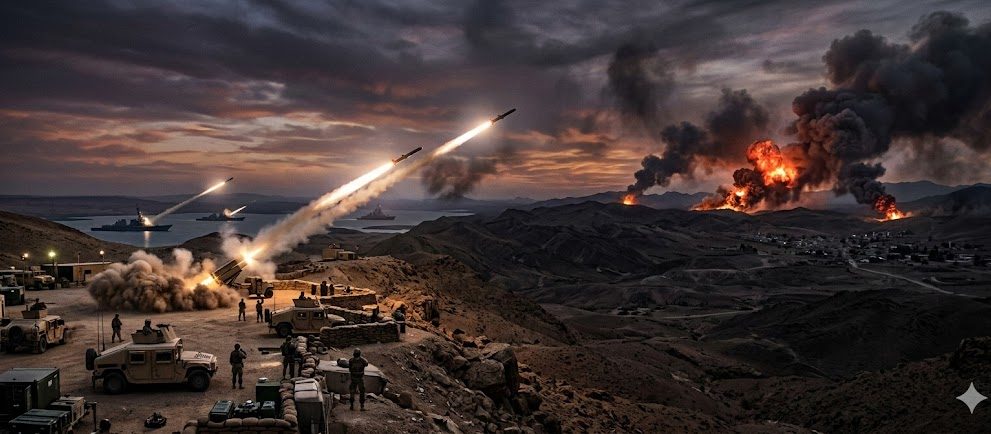
- Targets and Scope: Strikes have hit sites in Tehran, Isfahan, Qom, Kermanshah, Karaj, and Khorramabad. Reports indicate a focus on military infrastructure, including Islamic Revolutionary Guard Corps (IRGC) facilities, missile production and launch sites, air defenses, and possibly elements linked to Iran’s nuclear and ballistic missile programs. The campaign is expected to continue over several days and be more extensive than the U.S. strikes on three nuclear facilities during the June 2025 Twelve-Day War.
- Visual Evidence: Eyewitness accounts and videos show plumes of smoke over Tehran, with the first apparent strike near the offices of Supreme Leader Ayatollah Ali Khamenei. Social media footage captures explosions and emergency responses in affected areas.
Background to the Escalation
The strikes follow weeks of stalled nuclear negotiations in which the U.S. demanded Iran halt uranium enrichment, dismantle long-range ballistic missiles, end support for proxies like Hezbollah and the Houthis, and address ongoing domestic repression amid nationwide protests that have claimed over 30,000 lives since 2025.
The U.S. has deployed an unprecedented military presence in the region, including two carrier strike groups (USS Gerald R. Ford and USS Abraham Lincoln), fighter jets, bombers, and air defense systems—the largest buildup since the 2003 Iraq invasion. President Trump repeatedly warned of military action if Iran failed to comply.
This marks the second direct U.S.-Iran confrontation in less than a year, following American intervention in the 2025 Israel-Iran war, where U.S. forces targeted nuclear sites at Fordow, Natanz, and Isfahan.
Iranian Response
Iranian officials have condemned the attacks as “aggression” and vowed a “crushing” and “decisive” retaliation. An Iranian official stated Tehran is preparing for response, with IRGC forces mobilizing and remaining missile assets repositioned in hardened or mountainous sites. Proxies in Iraq, Lebanon, and Yemen have issued threats against U.S. bases and regional interests.
Iran’s missile capabilities, though degraded from prior conflicts, remain a significant threat, potentially targeting Gulf shipping lanes, including the Strait of Hormuz.
Global and Regional Impact
- Oil Markets: Brent crude surged sharply, with analysts warning of disruptions to global energy supplies if the conflict widens.
- International Reactions: The United Nations Secretary-General called for immediate de-escalation. European leaders expressed alarm, while allies like Saudi Arabia and the UAE monitor Iranian threats closely.
- Risks Ahead: Experts warn of potential for broader regional war, including proxy attacks, cyber operations, or attempts to close key waterways.
World Report Press is monitoring this rapidly evolving situation and will provide continuous updates. Stay tuned for further developments.