


Iran 1979 vs 2026: From Islamic Revolution to Existential Crisis – The Full Story

By NRIGlobe Desk | Updated March 2026
Forty-seven years separate the triumphant return of Ayatollah Ruhollah Khomeini in February 1979 and the chaos gripping Iran in March 2026. What began as a broad-based revolution against autocracy and foreign influence consolidated into a theocratic Islamic Republic that has survived wars, sanctions, and repeated uprisings. Today, the regime faces its most severe test: Supreme Leader Ayatollah Ali Khamenei is confirmed dead after joint U.S.-Israeli strikes (February 28–ongoing), nationwide protests have spread to all provinces amid economic collapse, and the leadership vacuum raises questions about succession, regime survival, and a potential new chapter in Iran’s history.
For the global Indian diaspora — with strong historical, trade, and energy ties to Iran — this moment carries profound implications. Below is the complete chronological story from 1979 to now, highlighting key events, contrasts, and what may come next.
1979: The Islamic Revolution – Overthrow of the Shah and Birth of the Islamic Republic
The revolution erupted amid widespread discontent with Shah Mohammad Reza Pahlavi’s rule: rapid Westernization, inequality, SAVAK repression, and perceived subservience to the U.S. and Britain.
- Key Events Timeline:
- January 1978: Protests erupt in Qom after a newspaper article insults Khomeini; security forces kill demonstrators.
- September 8, 1978 (Black Friday): Massacre in Jaleh Square, Tehran — dozens to hundreds killed.
- December 1978: Millions march during Ashura; “Allahu Akbar” chants from rooftops become a symbol.
- January 16, 1979: Shah flees Iran (officially a “vacation”).
- February 1, 1979: Khomeini returns from exile in France; millions greet him in Tehran.
- February 11, 1979: Armed forces declare neutrality; revolution victorious.
- April 1, 1979: Referendum approves Islamic Republic (98% yes).
- November 4, 1979: U.S. Embassy seized; 52 hostages held for 444 days.
The new constitution (December 1979) established Velayat-e Faqih (Guardianship of the Islamic Jurist), with Khomeini as Supreme Leader. Moderates were sidelined; strict Islamic laws enforced.
1980s: War, Consolidation, and Repression
- 1980–1988: Iran-Iraq War — Saddam Hussein invades (backed by West/Gulf states); over 1 million dead; chemical attacks on Iran. War ends in stalemate but empowers IRGC.
- 1988: Mass executions of political prisoners (thousands killed).
- 1989: Khomeini dies (June 3); Ali Khamenei becomes Supreme Leader.
1990s–2000s: Reconstruction, Reform Attempts, and Nuclear Program
- 1990s: Rafsanjani presidency focuses on rebuilding post-war economy.
- 1997–2005: Khatami’s reformist era — brief liberalization; “Dialogue of Civilizations.”
- 2002: Iran’s secret nuclear sites revealed; program accelerates.
- 2005–2013: Ahmadinejad presidency — Holocaust denial, uranium enrichment surge.
2010s: Green Movement, Nuclear Deal, and Maximum Pressure
- 2009: Green Movement protests election fraud; brutally suppressed.
- 2015: JCPOA nuclear deal signed — Iran curbs program; sanctions eased.
- 2018: Trump withdraws from JCPOA; reimposes “maximum pressure” sanctions.
- 2019–2020: Fuel protests crushed; Soleimani killed by U.S. drone; Iran downs Ukrainian airliner.
2020s: Protests, Regional Escalation, and Collapse
- 2022: Mahsa Amini’s death sparks “Woman, Life, Freedom” protests — largest since 1979.
- 2024: Reformist Masoud Pezeshkian elected president (low turnout); promises moderation.
- 2025: Nuclear talks fail; Iran enriches to near-weapons grade. June 2025 U.S.-Israel strikes hit Fordow, Natanz, Isfahan — set program back ~2 years.
- Late 2025: Economic crisis peaks — rial crashes (1.4 million+ to $1), inflation >40%, food prices +70%. Protests begin December 28 in Tehran Bazaar over prices; spread nationwide.
- January 2026: Regime crackdown kills thousands (estimates 16,500–36,500 in days); internet blackouts; arrests tens of thousands. Protests grow; calls for regime change.
- February 2026: Escalation — U.S.-Israel launch “Operation Epic Fury” / “Roar of the Lion” (Feb 28 onward) — strikes on leadership, nuclear remnants, missiles, navy. Khamenei killed (confirmed by Iranian state media); senior officials dead. Iran retaliates against U.S. bases (Bahrain, Qatar, UAE, etc.), Israel, and allies.
- March 2026: Khamenei’s death confirmed; 40-day mourning declared — but public celebrations in streets (dancing, defiance). Protests intensify; succession unclear (no clear heir; council formed). U.S. President Trump calls for uprising; regime faces fractures.
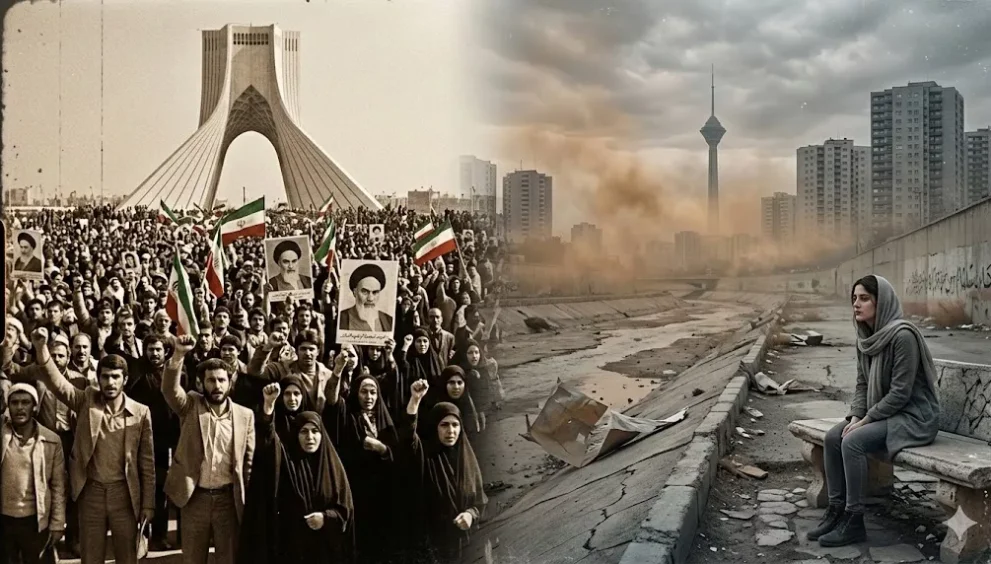
1979 vs 2026: A Stark Contrast
| Aspect | 1979 (Revolution) | 2026 (Current Crisis) |
|---|---|---|
| Trigger | Anti-monarchy, anti-Western protests | Economic collapse + strikes + leadership death |
| Leadership | Khomeini returns triumphantly | Khamenei killed; succession vacuum |
| Public Mood | Euphoria for change | Despair + defiance; celebrations at death |
| Economy | Oil boom inequality | Hyperinflation, rial collapse, poverty |
| International | U.S. Embassy hostage crisis | U.S.-Israel strikes; retaliation; isolation |
| Protests | Broad coalition topples Shah | Nationwide, anti-regime; calls for overthrow |
| Outcome | Islamic Republic established | Regime survival in doubt |
What Happens Next?
As of March 2026, Iran faces:
- Succession Crisis: No clear heir (Mojtaba Khamenei rumored but unconfirmed); council holds power temporarily.
- Protests: 40-day mourning ceremonies spark more demonstrations; regime crackdown ongoing.
- Military/Regional: Ongoing U.S.-Israel strikes; Iranian retaliation; weakened proxies (Hezbollah, etc.).
- Economy: Total collapse; middle class gone; potential defaults.
- Global Implications: Oil volatility; refugee risks; nuclear program remnants; diaspora concerns.
Iran’s 1979 revolution promised justice and independence — but delivered repression and isolation. In 2026, the people demand the change denied for decades. The outcome — collapse, transition, or renewed repression — will shape the Middle East and global security for years.