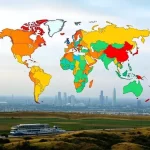



Trump’s 2026 Tariffs Explained: How Major Economies Are Affected Worldwide

Trump Tariffs 2026: Global Impact on Major Countries and Trading Partners – Worldwide Overview
As of mid-January 2026, President Donald Trump’s tariff policies—invoking the International Emergency Economic Powers Act (IEEPA)—have reshaped global trade. A baseline 10% tariff applies to most imports, with higher “reciprocal” rates on dozens of countries to address trade deficits. Additional punitive measures target issues like fentanyl flows, Russian oil purchases, and trade with Iran. The average effective US import tariff rate hovers around 17-21%, with some estimates at 10.91% weighted, but sector-specific rates (e.g., steel/aluminum at 41-50%) hit harder.
The US Supreme Court is reviewing the legality of broad IEEPA-based tariffs, with a ruling expected soon—potentially refunding billions if struck down. Tariffs have raised household costs (~$1,500-$2,100 per US household in 2026) but effects remain moderated by exemptions, deals, and supply chain shifts. Globally, they fragment trade, spur retaliation risks, and push diversification.
Key Tariff Categories Affecting Countries Worldwide
- Baseline & Reciprocal Tariffs A 10% minimum on most imports, plus country-specific reciprocal rates (10-50%+) for ~180+ countries/territories to zero out bilateral deficits. Higher for nations with large US trade surpluses or barriers.
- Russia Oil Buyers (Threatened 500% Tariffs) Trump backs a bipartisan bill (Sanctioning Russia Act) for up to 500% tariffs on countries buying Russian oil, gas, uranium, or energy products. Targets major buyers: China, India, Brazil. India already faces 50% tariffs (doubled in 2025 partly over Russian oil), prompting reduced imports. Bill could vote soon, pressuring diversification.
- Iran Trading Partners (25% Tariff) Effective immediately: 25% tariff on imports from any country trading with Iran (oil, goods, etc.). Affects over 140 nations, hitting hardest: China (Iran’s top partner, 77-80% of oil), India, Turkey (second-largest trader), UAE, Japan, South Korea. Adds to existing rates (e.g., China’s ~35%).
- Sectoral & Other Tariffs
- Steel/aluminum/copper: Up to 50% from most partners.
- Autos/heavy trucks: 25% threats/investigations.
- AI chips/semiconductors: 25% on select imports (e.g., Nvidia H200).
- Pharmaceuticals: Potential rises to 200% mid-2026.
Impact on Major Trading Partners & Countries (2026 Snapshot)
- China: Faces high reciprocal rates (~35-37% effective in some periods), plus Iran/Russia risks. Record $1.2T surplus in 2025 despite tariffs; diversification to Southeast Asia/Africa/Latin America cushions blows. Retaliation threats ongoing; fragile truce expires 2026.
- India: 50% tariffs (25% reciprocal + 25% Russia-linked); exports to US declined sharply in 2025. Reduced Russian oil buys (e.g., Reliance no January 2026 cargoes). Faces Iran 25% add-on. Diversifying to China/EU/UK.
- Brazil: High reciprocal rates (up to 50% in cases); targeted for Russian oil buys and political factors (e.g., Bolsonaro ties). 500% threat looms.
- Canada & Mexico: Fentanyl-linked tariffs (higher on non-USMCA goods); USMCA review by July 2026. Exemptions for many products, but uncertainty persists.
- EU (incl. Germany, France): Reciprocal rates vary; steel/aluminum at 50%. Some deals navigated exemptions; potential retaliation if pressures mount.
- Japan & South Korea: Completed deals lowering some rates (e.g., autos to 15%); but Iran trade adds 25% risk.
- Turkey, UAE, Iraq: Heavy Iran exposure triggers 25% tariff; baseline + sectoral hits.
- Others (e.g., UK): Some deals/quota exemptions (e.g., autos); pursuing relief.
Broader Global Implications in 2026
Tariffs raise US revenues (~$247B in 2026) but risk inflation, supply disruptions, and fragmentation. Many countries diversify away from US markets, forming regional blocs. Retaliation limited so far, but threats grow (e.g., China on elements). IMF forecasts muted global growth impact (~0.5% drag in scenarios), but prolonged uncertainty hurts investment.
Ongoing negotiations (e.g., US-India talks with new Ambassador Sergio Gor) and Supreme Court ruling could ease or escalate tensions. For the latest on Trump tariffs global impact 2026, US tariffs by country, and worldwide trade news, follow www.worldreport.press.