



UAE Rejects Simple Ceasefire with Iran, Demands Comprehensive Resolution of All Threats

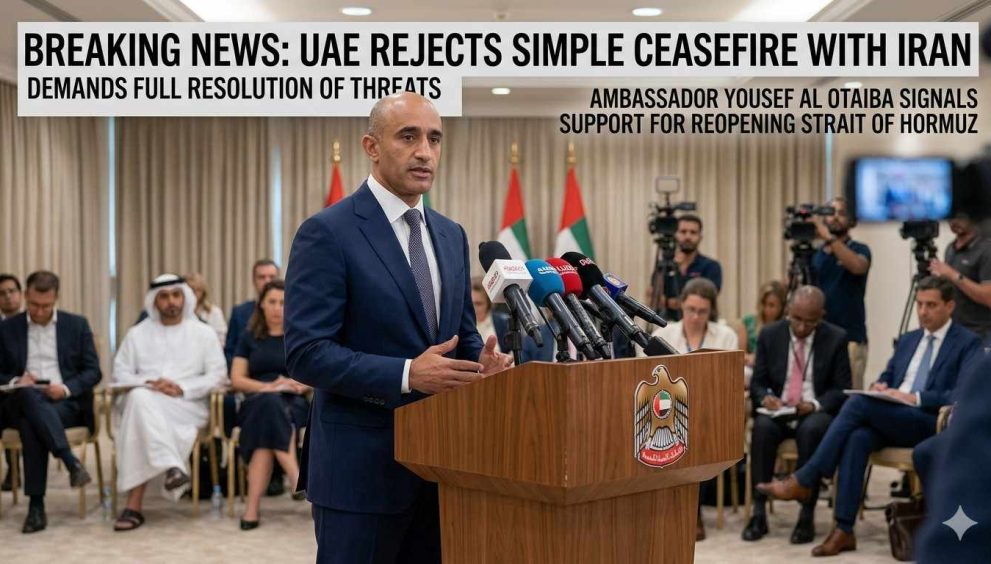
Ambassador Yousef Al Otaiba Signals UAE Readiness to Join Efforts to Reopen Strait of Hormuz While Reaffirming $1.4 Trillion Investment Commitment in the United States
Abu Dhabi / Washington, April 8, 2026 – The United Arab Emirates has taken a firm and unequivocal stance against a limited ceasefire with Iran, insisting that any agreement must fully neutralize Tehran’s wide range of threats, including its nuclear ambitions, ballistic missiles, drone capabilities, support for terror proxies, and attempts to blockade critical international waterways.
Senior UAE officials have made it clear that a temporary pause in hostilities would only postpone a more dangerous future confrontation rather than deliver lasting regional stability.
Strong Words from UAE Leadership
In a high-profile opinion piece published in The Wall Street Journal, UAE Ambassador to the United States Yousef Al Otaiba wrote: “A simple cease-fire isn’t enough. We need a conclusive outcome that addresses Iran’s full range of threats: nuclear capabilities, missiles, drones, terror proxies and blockades of international sea lanes.”
He warned that allowing Iran to continue its destabilizing activities would effectively let Tehran “hold the U.S., the United Arab Emirates, and the global economy hostage.”
Echoing this position, UAE Presidential Diplomatic Adviser Anwar Gargash emphasized that any settlement must guarantee unrestricted freedom of navigation through the Strait of Hormuz — the narrow chokepoint responsible for nearly 20% of the world’s daily oil supply.
“The Strait of Hormuz cannot be held hostage by any country,” Gargash stated. “Freedom of navigation through the waterway has to be part and parcel of the settlement of any conflict with clear agreement on that.”
The UAE has expressed willingness to actively participate in international efforts, including those led by the United States, to secure and reopen the Strait of Hormuz if Iranian actions continue to threaten global shipping.
Context of Escalating Tensions
The UAE’s hardened position comes after weeks of Iranian missile and drone attacks that have targeted Gulf infrastructure. The country has already intercepted more than 2,180 such projectiles using its advanced defense systems.
Despite the direct threats and regional instability, the UAE remains committed to its long-term strategic and economic partnership with the United States. Ambassador Al Otaiba recently reaffirmed the UAE’s $1.4 trillion investment commitment in the US over the coming decade. This massive investment package covers critical sectors including artificial intelligence infrastructure, semiconductors, energy, advanced manufacturing, and critical minerals.
In communications with the US-UAE Business Council, the Ambassador assured that the investment framework “will stay on track with plans to accelerate deployment and funding,” signaling strong confidence in the bilateral relationship even amid the current geopolitical turbulence.
Global Implications
The Strait of Hormuz remains one of the most strategically vital maritime routes on the planet. Any prolonged disruption could cause sharp spikes in global oil prices, supply chain chaos, and broader economic consequences.
The UAE’s call for a comprehensive resolution — rather than a fragile ceasefire — aligns with concerns shared by several Gulf nations that view a decisive long-term outcome as preferable to repeated cycles of escalation.
Ongoing Developments
As the US-Iran conflict continues to evolve, the UAE is maintaining close coordination with Washington and other international partners. The country continues to prioritize the protection of its sovereignty and citizens while pushing for a settlement that delivers genuine and lasting security for the region and the global economy.
WorldReport.press will continue to provide updates on this rapidly developing story, including its impact on energy markets, international diplomacy, and global security.