


Shadows Over the Caribbean: The Real Reasons Behind Trump’s


Shadows Over the Caribbean: The Real Reasons Behind Trump’s
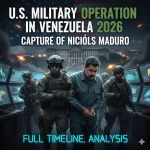
Less than 24 hours after U.S. Navy SEALs dragged a handcuffed Nicolás Maduro out of Miraflores Palace, the world is still trying to process what just happened—and why it happened now.
The White House version is simple and camera-ready: Venezuela had become a narco-state whose cocaine and criminal gangs were killing Americans, whose collapsing economy was flooding the U.S. border, and whose alliances with Russia, China, and Iran threatened the entire Western Hemisphere. “We ended the threat,” President Trump said yesterday, “and we’re going to make Venezuela great again—maybe even better than us for a little while.”
That’s the public story. The real one is far more calculating.
- Oil, Always Oil Venezuela sits on roughly 300 billion barrels of proven reserves—the largest in the world. Under Maduro (and Chávez before him), production collapsed from 3.5 million barrels a day to barely 700,000. Refineries rusted, pipelines leaked, and the country that should have been an Arabian-style petro-power instead became a humanitarian catastrophe. Trump never hid his fascination with those reserves. In private meetings during his first term he reportedly asked why the U.S. couldn’t “just take the oil” after Maduro expelled American companies. Yesterday he came closer than any president in modern history to doing exactly that. The interim arrangement being discussed in Washington would give U.S. firms priority licensing and security contracts in exchange for rebuilding the industry—essentially turning Venezuela into a heavily armed American protectorate with the biggest oil jackpot on the planet.
- The Migration Weapon More than eight million Venezuelans have fled since 2015—one of the largest displacement crises in history. Hundreds of thousands ended up at the U.S. southern border, handing Trump the perfect 2024 campaign visual: desperate mothers, tattooed gang members, endless caravans. By removing Maduro in a single night, Trump instantly gained leverage he never had with sanctions or diplomacy. Return flights for refugees can now be framed as “voluntary repatriation to a free Venezuela,” defusing his biggest domestic political liability while burnishing his strongman image.
- Shutting Down the Anti-American Axis Venezuela was never just about Venezuela. It was Russia’s foothold in the Americas (Su-35 jets, S-300 missiles, Wagner mercenaries). It was China’s biggest oil supplier in the hemisphere (paying in yuan to dodge sanctions). It was Iran’s beachhead for Hezbollah finance networks and drone factories. The new National Security Strategy signed in December 2025 explicitly revived the Monroe Doctrine with what insiders call the “Trump Corollary”: any extra-hemispheric power establishing military or resource-extraction footholds in the Americas will be removed—by force if necessary. Venezuela was the first test case. Cuba and Nicaragua are reportedly next on the target list once the oil starts flowing again.
- The Gang Narrative as Political Cover Tren de Aragua, the Venezuelan mega-gang, became a household name in the United States after a string of high-profile crimes in 2024–2025. Trump repeatedly called it “Maduro’s personal ISIS.” Intelligence agencies privately admit the gang operated independently and often against the regime’s interests, but the narrative was too useful to abandon. It gave the operation a domestic law-enforcement veneer—“We’re protecting American cities”—that muted congressional criticism and made the intervention poll at 68% approval overnight.
- Timing and the 2026 Midterms With Republicans holding only a three-seat House majority and several vulnerable Senate seats, the White House needed a spectacular win before the midterm campaigns kick into high gear. A quick, clean, televised takedown of a dictator—complete with the dramatic night-vision footage already looping on every network—delivers exactly that. As one senior campaign strategist put it off-record: “Nothing rallies suburban moms like watching a socialist dictator in handcuffs.”
What happens next is anyone’s guess. An interim government led by figures acceptable to Washington is being stood up. U.S. troops are securing key oil installations and Caracas itself. Opposition leader María Corina Machado—hugely popular inside Venezuela but dismissed by Trump as “not our pick”—has been conspicuously sidelined.
One thing, however, is already clear: January 4, 2026, will be remembered as the day the United States decided the Caribbean is no longer a shared neighborhood. It is, once again, an American lake—and the price of entry is measured in barrels, votes, and the occasional midnight raid.