




Budget 2026–27: India’s Growth Strategy Explained

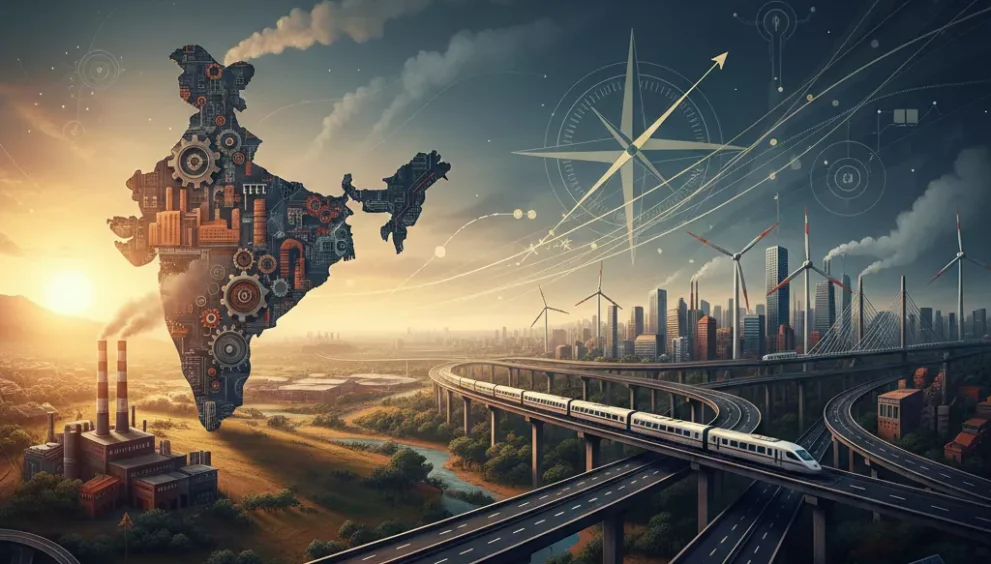
Budget 2026–27: India’s Growth Strategy Explained
India Budget 2026 latest news continues to dominate searches across the country. Just nine days after Finance Minister Nirmala Sitharaman presented the Union Budget 2026-27 on February 1, Google Trends data shows explosive interest in terms like “Union Budget 2026,” “capex India 2026,” “new income tax act,” and “semiconductor PLI.” Search volumes for budget-related queries surged by several hundred percent in the first week of February 2026, reflecting intense public, investor, and business scrutiny in a year marked by global trade tensions and India’s ambition to become a developed economy by 2047.
This India Budget 2026-27 stands out as a “Yuva Shakti-driven” document that prioritises capital expenditure, manufacturing self-reliance, and fiscal prudence over short-term populism. With public capex hiked to a record ₹12.2 lakh crore and a new Income Tax Act set to take effect from April 2026, the budget signals continuity in the government’s reform agenda while addressing emerging challenges like US tariffs and supply-chain realignments.
Macroeconomic Backdrop: Resilience Meets Caution
India enters FY 2026-27 on a strong footing. The Economic Survey 2025-26 projected 7.4% real GDP growth for the current fiscal (2025-26), driven by robust domestic consumption and public investment. For FY 2026-27, the government and RBI anticipate 6.8–7.2% expansion, while Moody’s Ratings forecasts 6.4% — still the fastest among G20 economies.
RBI Governor and economists highlight steady private consumption, a reviving investment cycle, and structural reforms (including labour codes and GST rationalisation) as key supports. However, external risks loom large: potential US tariffs under the Trump administration, geopolitical tensions, and moderating global demand.
Finance Minister Sitharaman framed the budget around three “kartavyas” (duties): accelerating economic growth, fulfilling citizen aspirations, and ensuring inclusive development. “This is a budget that transforms aspiration into achievement,” she said during her ninth consecutive presentation.
Record Capex Push: The Engine of Growth
The most striking feature of Union Budget 2026-27 is the 9%+ increase in public capital expenditure to ₹12.2 lakh crore (from ₹11.2 lakh crore in the previous year’s budget estimates). Effective capex, including grants, reaches nearly ₹17 lakh crore.
This continues a decade-long trend: capex has risen from ₹2 lakh crore in FY 2014-15 to over ₹12 lakh crore now. Economists compare it to the post-1991 liberalisation push and the post-COVID infrastructure stimulus of 2021-22. “Sustained high capex is crowding in private investment and creating productive assets,” noted a senior economist at EY India.
Key infrastructure announcements include:
- Seven high-speed rail corridors as “growth connectors.”
- A dedicated east-west freight corridor.
- Expansion of national waterways and coastal shipping targets.
- An Infrastructure Risk Guarantee Fund to de-risk private participation.
- Dedicated REITs for monetising CPSE real estate assets.
These measures aim to improve logistics efficiency, reduce costs, and support manufacturing competitiveness.
Manufacturing Renaissance: Seven Strategic Sectors
The budget doubles down on Atmanirbhar Bharat with targeted interventions in seven frontier sectors: semiconductors, electronics, critical minerals and rare earths, chemicals, pharmaceuticals and biopharma, capital goods, and textiles/sports goods.
Notable initiatives:
- ISM 2.0 for semiconductor manufacturing and supply chains.
- Enhanced outlay for electronics components.
- Rare earth corridors in Odisha, Kerala, Andhra Pradesh, and Tamil Nadu.
- Chemical parks on a plug-and-play model.
- ₹10,000 crore Biopharma Shakti scheme for biologics and biosimilars.
- ₹10,000 crore SME Growth Fund to nurture “champion MSMEs.”
Industry leaders welcomed the focus. “The budget positions India as a global manufacturing powerhouse amid supply-chain shifts,” said Saurabh Agarwal, Tax Partner at EY India. Critics, however, note that consumption stimulus remains limited, potentially constraining near-term demand.
Tax Reforms: Simplification Over Slabs
No changes to personal income tax slabs disappointed some middle-class taxpayers, but the budget introduces structural reforms. The new Income Tax Act, 2025 (effective April 1, 2026) promises simplified rules, fewer compliances, and reduced litigation.
Other tax measures:
- Rationalisation of TDS/TCS provisions (e.g., lower TCS on education/medical remittances).
- One-time disclosure scheme for small foreign assets.
- Increased STT on futures (from 0.02% to 0.05%), which contributed to post-budget market volatility.
- Customs duty tweaks: exemptions for critical minerals, lithium-ion battery components, nuclear and renewable energy equipment; some increases on chemicals and umbrellas for domestic protection.
Buyback taxation shifts to capital gains treatment from April 2026, and interest deductions against dividend income face restrictions.
Market reaction was initially negative — Sensex fell over 1,800–2,000 points on budget day — largely due to the STT hike and absence of major personal tax relief. Analysts now call it an overreaction. “Fundamentals remain strong; the budget prioritises long-term stability,” observed experts at RBL Bank.
Green Energy, Defence, and Inclusion
Union Budget 2026-27 allocates significant resources to energy security and climate goals:
- Funding for Carbon Capture, Utilisation and Storage (CCUS) technologies.
- Duty exemptions for nuclear power components and renewable inputs.
- Support for battery storage and critical minerals processing.
Defence spending rises to approximately ₹7.85 lakh crore (about 2% of GDP), bolstering indigenisation amid regional security concerns.
Social sectors receive attention through skilling, women’s hostels in STEM institutions, tourism guide upskilling, and AI tools for agriculture (Bharat-Vistaar).
Expert Insights and Stakeholder Reactions
Economists offer a largely positive but nuanced view. Moody’s praised the capex focus and fiscal consolidation path (deficit targeted at ~4.3% of GDP, debt-to-GDP trending lower). “India’s growth will remain the brightest spot in the G20,” the agency stated.
Cyril Shroff of Cyril Amarchand Mangaldas highlighted policy continuity: “At a time of geopolitical uncertainty, this budget reinforces that India is open for business.”
Industry bodies like CII and FICCI welcomed the MSME and manufacturing push, though some called for faster implementation of labour reforms.
Opposition parties criticised the budget for insufficient rural and consumption focus, accusing it of favouring corporates. Congress leaders described it as “tactical but not transformative.”
The Hindu and Times of India analyses note that success hinges on execution — land acquisition, state-centre coordination, and private investment response.
Historical Parallels and Long-Term Vision
This budget echoes the 1991 reforms in its emphasis on competitiveness and the 2014-19 infrastructure build-out. It builds on the 2021-22 and 2022-23 budgets’ capex thrust, which helped India rebound faster than peers post-pandemic.
By prioritising “City Economic Regions,” high-speed rail, and technology (AVGC labs in schools, AI in agriculture), the government aims to create jobs for India’s young population while addressing climate and urbanisation challenges.
For NRIs and global investors, measures like eased foreign portfolio norms, tax holidays for cloud providers, and trade deal momentum (EU FTA, US interim agreement) signal improved ease of doing business.
Challenges Ahead
Analysts point to risks:
- Global trade wars impacting exports.
- Implementation bottlenecks in states.
- Limited fiscal space for further stimulus.
- Need to boost private capex, which has been slower to recover.
Vibhuti Garg of IEEFA noted that while CCUS funding is welcome, more is needed on transmission and adaptation.
What It Means for You
For investors: Infrastructure, defence, semiconductors, renewables, and MSME-linked stocks may benefit over the medium term. Markets have stabilised post the initial dip.
For businesses: PLI expansions and customs reforms offer opportunities in strategic sectors.
For salaried individuals and taxpayers: Compliance eases from 2026-27; watch for updated return extensions and simplified forms.
For youth and job-seekers: Skilling, creative technology labs, and manufacturing growth promise expanded opportunities.
Conclusion: Prudent Optimism for Viksit Bharat
The Union Budget 2026-27 is neither populist nor revolutionary — it is a disciplined, forward-looking roadmap that bets on India’s structural strengths: a young demographic, digital infrastructure, and policy stability. By raising capex, simplifying taxes, and targeting strategic manufacturing, it seeks to convert global challenges into opportunities for self-reliant growth.
As India navigates 2026 amid uncertain geopolitics, the real test will be implementation speed and private sector response. Early market volatility appears contained, and expert consensus leans toward cautious optimism.
For more on India’s semiconductor ambitions, explore our earlier analysis on tech self-reliance. For sector-specific breakdowns, check our reports on defence modernisation and green hydrogen.
Jai Hind. Stay informed with World Report Press for continuing coverage of India Budget 2026 latest news and economic developments in 2026.
Follow us for more
- Latest tech news
https://worldreport.press/category/tech-news/ - Latest Grok Imagine 2026 update xAI rolls out 10-second videos
https://worldreport.press/tech-news/latest-grok-imagine-2026-update-xai-rolls-out-10-second-videos/ - How AI is reshaping banking in 2026 fewer branches smarter operations
https://worldreport.press/tech-news/how-ai-is-reshaping-banking-in-2026-fewer-branches-smarter-operations/ - Major worldwide news stories recap last week
https://worldreport.press/tech-news/major-worldwide-news-stories-recap-last-week/ - Breaking ChatGPT linked to 9 reported deaths including 5 alleged suicides
https://worldreport.press/tech-news/breaking-chatgpt-linked-to-9-reported-deaths-including-5-alleged-suicides-openai-under-fire-amid-lawsuits-and-musk-altman-clash/

