


Shroud of Turin DNA Study Hints at Indian Origins

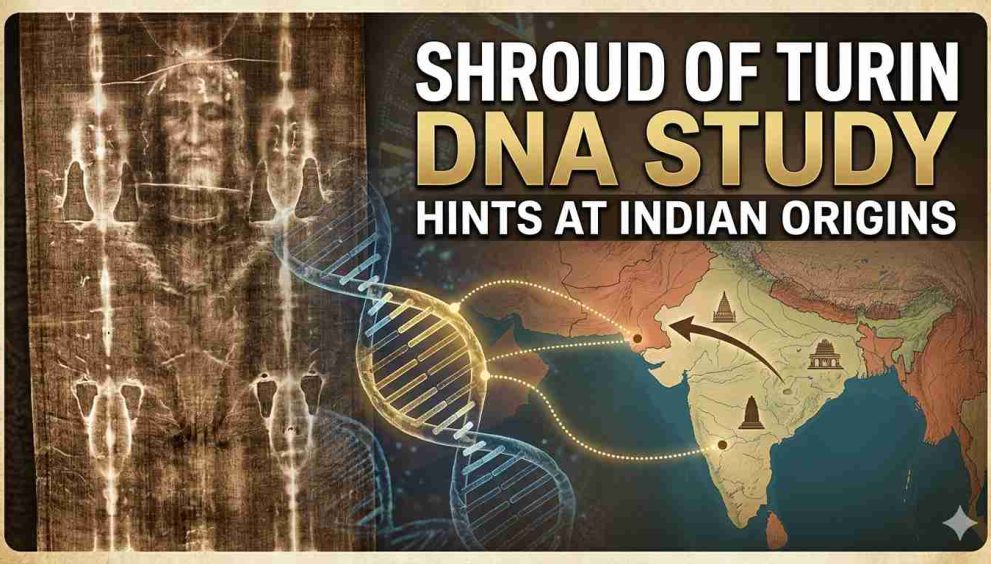
Shroud of Turin DNA Study Hints at Indian Origins
A groundbreaking new DNA analysis has added fresh intrigue to the world-famous Shroud of Turin, the linen cloth many Christians revere as the burial shroud of Jesus Christ. Researchers from the University of Padova, Italy, led by Professor Gianni Barcaccia, have re-examined material samples collected from the shroud in 1978. Their latest findings, shared on the preprint server bioRxiv (awaiting full peer review), reveal that nearly 40% (approximately 38.7%) of the human DNA traces on the cloth belong to Indian genetic lineages — pointing strongly to possible ancient roots in the Indian subcontinent, particularly the Indus Valley region.
For the NRI (Non-Resident Indian) community and global Indian diaspora — whether in the US, UK, Canada, Gulf countries, or elsewhere — this discovery is a powerful reminder of our ancient civilizational strength, innovation in crafts, and far-reaching trade networks that connected Bharat to the Mediterranean world over 2,000 years ago.
What the Latest DNA Analysis Shows
The team used advanced metagenomic sequencing on dust and fiber samples to trace human, plant, animal, and microbial DNA accumulated over centuries.
Key highlights include:
- Dominant Indian component: Around 38.7% of the human genomic data links to South Asian (Indian subcontinent) lineages, including characteristic haplogroups such as M39, M56, R7, and R8. This builds directly on Barcaccia’s earlier 2015 study that first highlighted rare Indian haplotypes.
- Mixed global traces: Over 55% of the DNA points to Near Eastern origins, with smaller inputs from Western Europe and other regions — reflecting the shroud’s long history of veneration, travel, and handling across Jerusalem, Turkey, France, and Italy.
- Linen from India?: Researchers suggest the flax yarn or fine linen may have been produced near the Indus Valley and traded into the Roman world. The Greek word “Sindôn” (used in the Bible for the shroud) possibly derives from “Sindh” — the historic region in the Indian subcontinent renowned for superior textiles since ancient times. Rabbinic texts even mention “Hindoyin” fabrics from the Indus area.
- Heavy contamination expected: The shroud has been touched by thousands of pilgrims, clergy, and handlers over centuries, plus modern sampling. Scientists clearly state the DNA mix does not identify any specific person (including Jesus) and cannot settle debates about the shroud’s religious authenticity.
The 1988 radiocarbon dating had suggested a medieval origin (though contested by some experts), and the new genetic data adds context to its material journey rather than proving or disproving its age or origins.
NRI Perspective: Celebrating Bharat’s Timeless Global Footprint
As NRIs, we often take pride in India’s ancient contributions to science, mathematics, philosophy, and now — through this study — even to a relic central to another faith. The Indus Valley Civilization (Harappan era, over 4,000 years ago) was a global leader in urban planning, cotton cultivation, dyeing, and weaving. Fine textiles from Bharat were luxury exports to Rome, Egypt, and the Middle East, creating significant trade surpluses that Roman writers like Pliny the Elder famously complained about.
Our ancestors’ maritime and overland routes — documented in texts like the Periplus of the Erythraean Sea — carried not just goods but ideas and culture. It is entirely plausible that premium Indian linen found its way to the eastern Mediterranean for important uses, including burial cloths.
This finding resonates deeply with the Indian diaspora. Whether you are a tech professional in Silicon Valley, a doctor in London, an engineer in Dubai, or a business owner in Singapore, it reinforces that Bharat’s influence has always been global. Our “soft power” — from yoga and spirituality to world-class craftsmanship — is not new; it is millennia old.
The linguistic clue is especially meaningful: “Sindôn” linking to Sindh (from the sacred Sindhu river, source of the name “India” or “Hind” in many languages) shows how our geography and products shaped distant narratives. In a world where Indian-origin professionals and entrepreneurs continue to excel across borders, this story feels like a historical echo of today’s success.
Importantly, the DNA evidence highlights interconnectedness. While the Shroud remains a sacred symbol for millions of Christians, its possible Indian material origins illustrate Vasudhaiva Kutumbakam — the world as one family — a core Hindu philosophical view that many NRIs carry with them.
Why This Matters for the Indian Diaspora
In an era when we celebrate Indian achievements in space (ISRO), technology, medicine, and culture, this study offers another layer of civilizational pride without diminishing anyone else’s faith. It encourages us to support more interdisciplinary research involving Indian scholars in genetics, archaeology, and ancient trade studies.
The full scientific picture is still emerging, and interpretations will evolve with peer review. Yet the high proportion of Indian-linked DNA traces serves as a fascinating testament to ancient Bharat’s excellence in textile arts and global commerce.
For NRIs worldwide, this is an opportunity to reflect on our rich heritage while building bridges in our adopted countries. Our roots run deep — from the looms of the Indus Valley to the cathedrals of Europe, and now in the hearts and achievements of millions of Indians living abroad.
Jai Hind. Proud to be Indian — wherever we are.
This article offers a balanced, informative overview based on the latest reported DNA findings from a global Indian diaspora perspective. Scientific conclusions continue to be studied and verified.
NRI Globe – Connecting the Indian Diaspora with Heritage, News & Pride