



World Update April 2026: US-Iran War, Moon Mission

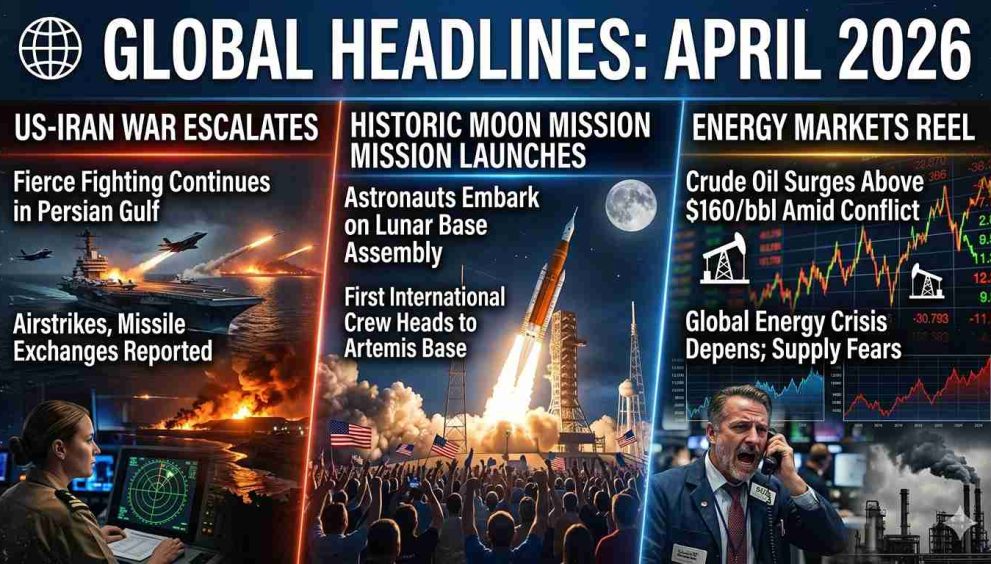
As April 2026 opened, the world remained gripped by the escalating US-Israel military campaign against Iran, now in its fifth week. Retaliatory strikes, a near-blockade of the Strait of Hormuz, and mounting civilian and military casualties dominated international attention. Against this backdrop of tension, NASA achieved a landmark moment in space exploration, while regional powers navigated economic fallout, diplomatic maneuvering, and domestic pressures. Oil prices surged past $100–$110 per barrel, raising fears of broader inflation and supply disruptions.
United States: Trump Addresses Nation on Iran War Amid Cabinet Shake-Ups and Aviation Losses
President Donald Trump delivered a primetime address on April 1, framing the military operation (dubbed “Operation Epic Fury”) as largely successful and signaling it could conclude in 2–3 weeks if Iran meets key demands, including reopening the Strait of Hormuz. He warned of further strikes on infrastructure and even floated the idea of the US securing Iranian oil resources.
However, the conflict intensified on April 3 when Iranian forces shot down a US F-15E fighter jet over Iran — the first manned US aircraft lost in the campaign — with one crew member rescued and search efforts continuing for the second. A second US aircraft (reportedly an A-10) was also struck near the Strait of Hormuz. These incidents raised the US military death toll to 13, with hundreds wounded.
In a major domestic shake-up, Trump dismissed Attorney General Pam Bondi and replaced her with his former personal lawyer Todd Blanche as acting AG. Defense Secretary Pete Hegseth also requested the departure of Army Chief of Staff General Randy George. A partial government shutdown drama persisted over Department of Homeland Security funding, tied to border security disputes.
On a brighter note, NASA’s Artemis II mission launched successfully on April 1 from Kennedy Space Center, sending four astronauts (including Canadian Jeremy Hansen) on the first crewed lunar flyby in over 50 years.
Iran and the Middle East: Retaliatory Strikes, Civilian Toll, and Hormuz Blockade
Iran faced intense US-Israeli strikes targeting nuclear facilities, missile sites, bridges (including a major Tehran-Karaj link), and infrastructure. Iranian President Masoud Pezeshkian urged the American public to question the war’s narrative. Tehran retaliated with missile and drone attacks on Israel, Gulf states (Saudi Arabia, UAE, Kuwait, Qatar, Bahrain), and US assets, claiming successes including the downing of US aircraft.
The effective closure of the Strait of Hormuz — through which ~20% of global oil and LNG flows — triggered severe energy disruptions. Shipping traffic dropped sharply, with some vessels hit. Civilian casualties in Iran reportedly exceeded 1,600 (including children), while broader regional deaths topped 3,000–4,000, with millions displaced. The UN warned of risks of a “wider war” and humanitarian catastrophe.
Gulf Cooperation Council (GCC) nations appealed to the UN Security Council for action to reopen the strait and condemned Iranian attacks on their infrastructure (including fires at Kuwait’s airport and damage to UAE facilities). Subtle differences emerged within the GCC: Saudi Arabia and UAE appeared more hawkish, while Qatar and Oman emphasized diplomacy.
Israel continued operations in southern Lebanon, striking bridges and reporting damage from Iranian missiles. Humanitarian concerns mounted across Gaza, Lebanon, and Syria.
Europe: Diplomatic Caution, Energy Concerns, and Domestic Debates
European leaders, including French President Emmanuel Macron, urged restraint and multilateralism. Macron, speaking during an Asia tour, criticized inconsistent messaging on the conflict and reiterated that France would not join military operations. Paris joined calls for freedom of navigation but vetoed certain UN resolutions authorizing force.
Rising oil prices pushed European fuel costs higher, prompting discussions on targeted relief and accelerated green energy transitions. The EU continued navigating relations with the US under Trump, while monitoring the Russia-Ukraine conflict, where President Zelenskyy criticized Russian strikes despite Easter truce overtures and praised US-mediated talks.
Russia and Ukraine: Ongoing Conflict with Diplomatic Glimmers
Fighting persisted in Ukraine, with Russian airstrikes drawing condemnation from President Volodymyr Zelenskyy. Fresh US-mediated talks offered a “positive” note, though a full resolution remained elusive as the war entered its fifth year. Russia faced indirect pressure from global energy shifts caused by the Iran crisis.
India: Energy Security Focus Amid Hormuz Disruptions
India, heavily reliant on Gulf oil imports, engaged diplomatically for safe passage of vessels. The government cut excise duties on fuel to shield consumers as prices rose. Iran reassured “Indian friends” of security for select shipping. Domestically, the first phase of the landmark digital Census 2027 began on April 1, while Prime Minister Narendra Modi highlighted infrastructure reforms and counter-insurgency gains (e.g., Maoist surrenders in Chhattisgarh).
China: Strategic Positioning and Regional Diplomacy
China, alongside Russia, opposed certain UN actions on the Hormuz crisis. Beijing hosted or supported talks, including Pakistan-Afghanistan peace discussions, while advancing its own interests amid global trade and technology rivalries. The Iran conflict offered opportunities for diplomatic influence and energy diversification.
Canada: Pride in Space and Domestic Political Pressures
Canadian astronaut Jeremy Hansen joined the Artemis II crew, marking a national milestone as the spacecraft headed toward the Moon. At home, Prime Minister Mark Carney engaged with Trump on the Iran situation while facing opposition calls (from Pierre Poilievre) for fuel tax relief amid rising prices. By-elections and trade irritants with the US added to the political mix.
Other Notable Developments
- Global Economy: Oil prices surged, with Brent and WTI benchmarks reflecting supply fears. Markets showed volatility; analysts warned of deeper disruptions if the Hormuz closure persisted.
- Space Achievement: Artemis II’s successful launch and early mission updates captured worldwide attention, symbolizing humanity’s return to deep-space exploration.
- Humanitarian and UN Efforts: The UN Secretary-General warned of catastrophic risks, while GCC nations pushed for Security Council measures on navigation and civilian protection.
Outlook for the Coming Weeks
The Iran conflict remains the defining story, with potential for de-escalation, prolonged fighting, or wider regional involvement. Energy markets will continue reacting to Hormuz developments, while the Artemis II mission offers a counterpoint of scientific hope. Diplomatic efforts at the UN and bilateral levels will shape whether the crisis narrows or expands.
This week illustrated a world balancing geopolitical confrontation with technological ambition, where distant conflicts in the Middle East ripple into fuel prices, inflation, and policy debates from Washington to New Delhi and Brussels.