



Climate Migration Pressures Mount in the Sahel Region in 2026

Climate Migration Pressures Mount in the Sahel Region in 2026
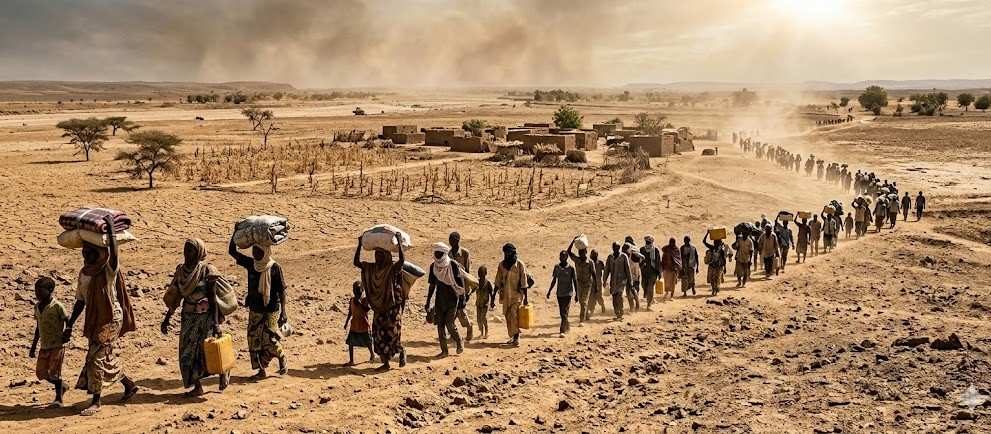
DAKAR/N’DJAMENA — Climate‑driven migration pressures across Africa’s Sahel region have intensified in 2026, as prolonged droughts, erratic rains and land degradation push more families to abandon farms and villages in search of water, work and safety. The quiet exodus is straining fragile governments, complicating security operations and reshaping migration routes toward North Africa, Europe and, increasingly, the Americas.
From Mauritania and Mali in the west through Burkina Faso, Niger and Chad to Sudan in the east, community leaders and aid groups say weather extremes and dwindling livelihoods are converging with conflict and political instability. The result is a slow‑motion crisis that officials warn is harder to capture than a single disaster but more consequential over time.
“People are not leaving because of one flood or one drought — they are leaving because the pattern has broken,” said a regional climate official based in Dakar. “The rainy seasons are shorter and more unpredictable, the grazing lands are shrinking, and families no longer see a future in the same place.”
A Region on the Climate Frontline
The Sahel — a semi‑arid band south of the Sahara stretching across the African continent — has long been one of the world’s most climate‑vulnerable regions. Temperatures there are rising roughly 1.5 times faster than the global average, according to UN assessments, while rainfall patterns have become more erratic, swinging between intense storms and prolonged dry spells.
In 2026, scientists monitoring the region report:
- Below‑average rainfall for several consecutive seasons in parts of Mali, Burkina Faso and Niger.
- Advancing desertification in northern Nigeria, Niger and Chad, reducing pasture for livestock.
- More frequent flash floods in urban areas, damaging homes and infrastructure originally built for drier conditions.
For communities reliant on rain‑fed agriculture and pastoralism, these shifts translate into failed harvests, livestock losses and rising food insecurity. Combined with population growth and ongoing conflict with armed groups in parts of Mali, Burkina Faso, Niger and Nigeria, the environmental stress is pushing more people to move — sometimes within their countries, sometimes across borders.
“In past years, we saw seasonal migration as people followed grazing or markets,” said a humanitarian worker in Niamey. “Now more families are leaving with all they own, saying they don’t plan to come back. That is a sign of deeper climate pressure.”
Invisible Journeys, Growing Numbers
Unlike high‑profile refugee crises triggered by wars or natural disasters, climate‑related migration in the Sahel often unfolds quietly. Families may move from rural areas to nearby towns, then from towns to regional hubs, before some members continue on to coastal countries or North Africa.
Official statistics understate the scale, analysts say, because many movements are internal or informal. Still, recent estimates from international organizations suggest that:
- Millions of people in the Sahel are living in areas highly exposed to climate hazards.
- Hundreds of thousands have been newly displaced or have migrated in 2025–2026 for reasons in which climate stress is a major factor.
- Future projections point to tens of millions of potential internal climate migrants across West and Central Africa by mid‑century without stronger adaptation efforts.
“You rarely hear someone say, ‘I left only because of climate change,’” said a migration researcher based in Abidjan. “They will mention debt, conflict, lack of work, family reasons. But when you look closely, you see that the land can no longer support the same number of people — that is the climate thread running through their stories.”
Urban Pressure and Social Tensions
As rural livelihoods falter, many families are heading to cities such as Bamako, Ouagadougou, Niamey, N’Djamena and Khartoum, hoping to find work, education and services. The influx is putting additional pressure on already stretched urban infrastructure.
Municipal officials in several Sahel capitals report:
- Informal settlements expanding on city outskirts, often in flood‑prone or poorly serviced areas.
- Rising demand for water, electricity and waste management in neighborhoods that were not designed for rapid growth.
- Competition over low‑wage jobs, sometimes fueling tensions between new arrivals and long‑time residents.
“We are seeing the rural crisis translated into an urban crisis,” said a city planner working with authorities in N’Djamena. “If climate adaptation does not reach the countryside, cities will continue to absorb people faster than they can provide services.”
In some regions, climate‑related movements also intersect with ethnic and communal lines, heightening the risk of localized conflict between farming and herding communities competing for shrinking resources.
Security Concerns in a Volatile Region
The Sahel has been a focus of international security efforts for years due to the presence of armed groups, including jihadist organizations and criminal networks. Analysts warn that climate‑driven displacement could create new vulnerabilities that such groups might exploit.
Displaced families with limited access to food, jobs or education are at higher risk of recruitment or coercion, security experts say. Areas where state presence is weak and basic services are absent can become recruitment grounds or logistical corridors for armed actors.
“Climate stress does not automatically cause conflict, but it can pour fuel on existing fires,” said a Sahel security analyst based in Dakar. “When communities feel abandoned and are fighting over land and water, extremist groups can present themselves as protectors or providers.”
For US and European policymakers, the intersection of climate, migration and security in the Sahel is a growing concern. Washington has highlighted the region in its climate security assessments, and European governments see links between Sahel instability and migration pressure toward the Mediterranean.
Routes Toward North Africa, Europe and Beyond
As climate pressures build, some Sahel migrants are joining established routes through Niger, Libya and other North African states in hopes of reaching Europe. Others head west toward coastal nations like Senegal and Ivory Coast, or south toward Nigeria and the Gulf of Guinea.
More recently, analysts have noted a small but notable trend: some West and Central African migrants traveling onward from North Africa or Latin America toward the United States and Canada, often via irregular routes through the Darién Gap and Central America.
“Climate is not the only factor in these journeys, but it is widening the pool of people considering migration as their only option,” said the migration researcher. “What begins as a move from village to town can, over time, become part of intercontinental migration flows.”
Adaptation Efforts Struggle to Keep Pace
Governments in the Sahel, together with international donors, have launched a variety of climate adaptation projects in recent years. These include:
- Reforestation and agroforestry initiatives to restore degraded land.
- Water harvesting and irrigation schemes to stabilize agricultural yields.
- Support for climate‑resilient crops and farming techniques.
- Investment in early warning systems for droughts and floods.
One of the flagship efforts, the Great Green Wall initiative, aims to restore millions of hectares of land across the Sahel through a mosaic of local projects. While progress has been uneven, some communities report improvements in soil fertility and income where interventions have been sustained.
But experts say funding gaps, insecurity and weak local governance mean adaptation measures are often outpaced by the speed and scale of climate impacts.
“There are promising examples on the ground, but they are not yet at the scale needed to change the trajectory,” said an official with a regional development bank. “Without significantly increased investment and political stability, climate migration will continue to rise.”
Youth at the Center of the Storm
The Sahel has one of the world’s youngest populations, with a large share under the age of 25. For many young people, climate stress is colliding with limited job prospects and political uncertainty.
In town after town, younger residents describe a sense of being stuck between a home environment that feels less viable and destination countries that are hard to reach and not guaranteed to offer safety or prosperity.
“We cannot live as our parents did, depending only on rain,” said a young farmer from central Niger who recently moved to a regional city. “But there is no factory, no big company here either. Some of my friends talk about going to Libya or Europe. It is not because they want to leave; it is because they do not see another path.”
Local civil society groups are calling for more investment in education, vocational training and digital connectivity to provide alternatives to migration and recruitment by armed groups.
International Attention, But Competing Crises
International organizations have labeled the Sahel a “climate hot spot,” and climate migration from the region has been highlighted in global forums, including UN climate conferences. Yet aid agencies say they are competing for funding and attention with other high‑profile crises, from conflicts in Eastern Europe and the Middle East to extreme weather events in Asia and the Americas.
“The Sahel is a slow‑burn crisis that does not always make headlines,” said a senior official with an international humanitarian agency. “But for communities there, every failed rainy season is another step toward displacement or deeper poverty.”
US and European governments have pledged support for climate adaptation and development in the region, but analysts say coordination between security assistance and climate programming remains uneven.
“If you invest in security without investing in livelihoods and resilience, you are treating symptoms, not causes,” said the security analyst. “Climate migration is a signal that underlying systems are under strain.”
Calls for a Comprehensive Response
Experts and regional leaders argue that addressing climate‑driven migration in the Sahel requires a comprehensive approach that goes beyond emergency aid. Priorities they highlight include:
- Scaling up adaptation funding for rural communities to make staying a viable option.
- Strengthening land rights and conflict resolution mechanisms between herders and farmers.
- Investing in climate‑resilient infrastructure in growing towns and cities.
- Creating legal and safe pathways for regional mobility and seasonal work.
Some also call for clearer recognition of climate‑related displacement in international law and migration frameworks, arguing that many people leaving the Sahel fall into a gray area between traditional refugee and economic migrant categories.
“People are moving because climate change has undermined the basic conditions of life, but our systems are not designed to recognize that,” said the policy director at the Washington‑based civil liberties organization. “We need to update our thinking before the numbers grow even larger.”
Implications Beyond the Sahel
While the immediate impacts of climate migration in the Sahel are felt within Africa, policymakers in North America and Europe are beginning to factor the region more prominently into long‑term planning. US officials have referenced the Sahel in climate security strategies, and European discussions on migration now include more explicit references to climate stress in origin countries.
Some analysts caution against framing Sahel migration as solely a security or border issue for wealthy countries, emphasizing instead the need for sustained development and climate finance partnerships.
“If the only response from the global North is stronger borders, the underlying pressures will keep building,” said the professor of security studies. “The Sahel is a test case for whether the world will treat climate migration as a shared challenge or as someone else’s problem.”
An Unfolding Test for Climate Justice
For many Sahel communities, the climate crisis feels doubly unjust: they contribute relatively little to global greenhouse gas emissions yet bear outsized impacts. The question of who pays for adaptation, loss and damage, and migration support is increasingly part of discussions between African leaders and global institutions.
As 2026 unfolds, families across the Sahel are making life‑changing decisions based on erratic rains and barren fields. Whether they find stability in a nearby town, a neighboring country or along a perilous route toward Europe or the Americas will depend in part on decisions made far from their villages — in national capitals, donor conferences and climate negotiations.
“Climate migration in the Sahel is not just about movement; it is about dignity, survival and justice,” said the regional climate official. “How we respond now will echo far beyond this region, and far beyond this year.”