


Christmas Returned to Bethlehem in 2025—But the Lights


Christmas Returned to Bethlehem in 2025—But the Lights
After two years of canceled celebrations, the birthplace of Jesus flickered back to life under fragile ceasefire. Yet as carols rang through Manger Square, the pain of Gaza and the West Bank’s deepening crisis turned joy into something far more complicated—and far more urgent.
December 26, 2025 – If you’ve ever tried to smile through tears at a holiday table after losing someone you love, you already understand Bethlehem this Christmas.
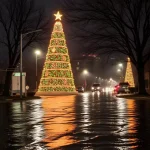
For the first time since 2022, the city dared to celebrate again. The towering Christmas tree in Manger Square glowed with thousands of warm white lights. Palestinian scout troops marched in crisp uniforms, bagpipes echoing off stone walls. Midnight Mass at the Church of the Nativity drew standing-room-only crowds—families squeezed shoulder-to-shoulder, children perched on parents’ laps, everyone breathing the same ancient, sacred air.
But the joy felt… incomplete. Half-formed. Like a song that keeps missing its final note.
Mayor Maher Nicola Canawati had called the decision to resurrect Christmas “a choice of life over death.” After two straight years of deliberate darkness—no lights, no decorations, no public festivities in solidarity with Gaza’s unimaginable suffering—the city chose light anyway. Not because everything was fixed. Not because the war had ended. But because giving up hope completely would have been the real defeat.
And yet the numbers tell a story that no amount of twinkling lights can soften:
- Unemployment in Bethlehem governorate soared past 65% in 2025 (up from 14% pre-October 2023).
- More than 4,000 residents—many of them young families—permanently left the city this year searching for work elsewhere.
- Tourism, which once accounted for over 70% of the local economy, remained almost completely frozen.
- The West Bank saw the highest number of people displaced since 1967—over 30,000 forced from their homes in 2025 alone through demolitions, settler violence, and military orders.
While Bethlehem tried to reclaim its Christmas spirit, Gaza—only about 80 kilometers away—remained a landscape of grief. Even with the U.S.-brokered ceasefire that took effect in mid-October, reports of sporadic drone flights, distant explosions, and ongoing humanitarian catastrophe filtered through phones and whispered conversations. More than 70,000 lives lost over two years. Entire generations growing up knowing only tents, rationed water, and intermittent electricity.
Cardinal Pierbattista Pizzaballa, the Latin Patriarch of Jerusalem, had just returned from Gaza when he led the traditional procession down Star Street on Christmas Eve. He described celebrating Mass inside a shattered church, surrounded by children who still sang hymns despite everything. “I saw disaster,” he told the crowd in Manger Square, voice steady but heavy. “But I also saw people refusing to let their humanity be destroyed.”
That refusal was everywhere you looked.
Families who had lost relatives kept coming to church. Shopkeepers with empty stores still strung fairy lights above their doorways. Young people posted defiant selfies under the tree with captions that mixed Arabic, English, and broken hope: “We are still here.” “Christmas in Palestine means resistance.”
One man from Beit Sahour, standing near the giant tree, summed it up for a local reporter: “Today is half joy, half sadness. We light the tree, we sing the songs, but we know our brothers and sisters are still dying.”
That sentence captures the emotional mathematics of Bethlehem 2025 better than any headline ever could.
Why This Christmas Felt Different
Traditional Christmas in Bethlehem used to be spectacle and pilgrimage: international choirs, foreign dignitaries, tour buses clogging the narrow streets. This year was quieter. More local. More Palestinian.
No fireworks (too close to the sound of war). No extravagant parades (money was too tight). But also no pretense.
People came because they needed to see each other alive, smiling, singing—even if the smiles trembled. They came because skipping Christmas entirely would have meant admitting the darkness had won completely. And after two years of canceled celebrations, that surrender felt unbearable.
Palestinian Christians, who make up roughly 10–12% of Bethlehem’s population, have always understood Christmas as more than tinsel and presents. It’s the story of a family turned away from every door, giving birth in a stable because empire had no room for them. In 2025, that story didn’t feel ancient. It felt current.
Displacement. Rejection at checkpoints. Homes demolished without warning. Babies born in tents because hospitals are overwhelmed or destroyed.
The nativity isn’t nostalgia here. It’s recognition.
What Happens When Hope Is an Act of Defiance
Across social media and WhatsApp groups, Palestinians shared the same bittersweet phrase over and over: “Christmas returned, but not the same.”
Some called it resilience. Others called it survival. A few quietly admitted it felt like pretending.
But pretending, in this context, is not weakness. It’s strategy.
Lighting a tree when your city is economically strangled is defiance. Singing carols when drones still hum overhead is defiance. Gathering in the Church of the Nativity—built in the 4th century, bombed and rebuilt and bombed again across centuries—is perhaps the oldest form of defiance there is.
Because every light switched on says: We are still here. Our story is not finished. The darkness has not won yet.
The Question That Lingers on December 26
As the decorations start coming down and the cold January wind moves in, the real question isn’t whether Bethlehem celebrated Christmas in 2025.
It did. Stubbornly. Beautifully. Painfully.
The real question is whether the rest of the world finally heard what Bethlehem has been whispering for years:
Peace is not the absence of bombs. Peace is the presence of dignity. Peace is room at the inn. Peace is justice that doesn’t stop at a checkpoint. Peace is the right to sleep without wondering if your home will still be standing in the morning.
Until those things arrive, Christmas in Bethlehem will always feel half-broken.
But here’s the part that refuses to die: Even half-broken, the light still shines.
And every year that people choose to light the tree anyway—every year they choose carols over silence, gathering over isolation—that light burns a little stronger.
The darkness is loud. The darkness is heavy. The darkness has drones and checkpoints and headlines on its side.
But it has never—never—been able to completely extinguish the stubborn, flickering, defiant light of people who refuse to disappear.
In Bethlehem, on Christmas 2025, that light burned again.
Not perfectly. Not triumphantly. But fiercely.
And that, maybe, is the only kind of Christmas miracle we’re allowed right now.
The kind that doesn’t promise everything will be okay tomorrow. The kind that simply promises we’re not done fighting for okay yet.
Keep watching the lights in Manger Square. They haven’t gone out. And as long as they stay on—even flickering—we still have time