



Hanuman Jayanthi 2026 Celebrated Worldwide

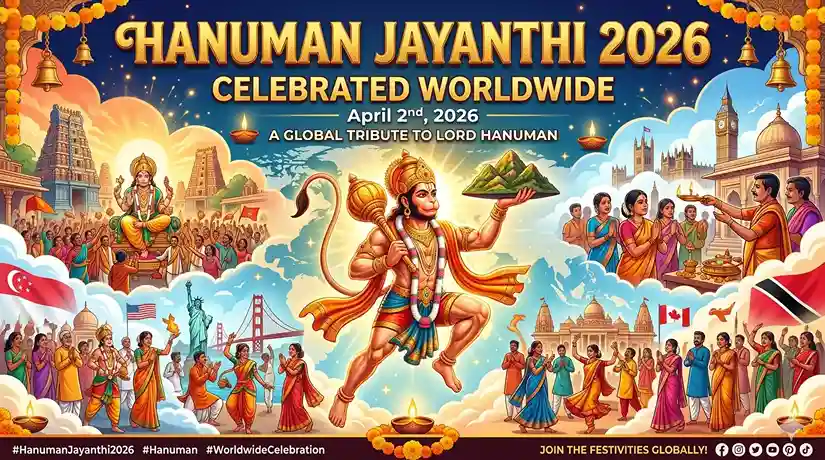
Hanuman Jayanthi 2026 Celebrated Worldwide
GLOBAL REPORT, April 2, 2026 — From temple bells ringing in New Jersey to the scent of jasmine oil wafting through a Houston suburb at 5 AM; from a Gujarati family in Leicester processing through streets in a rath yatra, to a Telugu software engineer in Seattle beginning his 41-day deeksha — April 2, 2026 belongs to one deity: Bajrangbali.
Hanuman Jayanthi 2026 — the Hindu festival commemorating the birth of Lord Hanuman, the son of the Wind God and the supreme devotee of Lord Rama — is being observed today across more than 150 countries, with the global Indian diaspora of approximately 35 million people making this one of the most geographically dispersed religious observances of the contemporary world.
The festival falls on Chaitra Purnima (Full Moon Day) of the Hindu lunar calendar — confirmed as Thursday, April 2, 2026, under the Udaya Tithi principle, since the full moon Tithi prevails at sunrise on April 2 in India. The occasion is not merely a religious anniversary. For Indians living abroad, it is a cultural, sociological, and deeply personal event — one that carries implications for identity, community, and the remarkable resilience of Hindu traditions across generations of diaspora life.
By the Numbers: A Festival Without Borders
The scale of Hanuman Jayanthi 2026’s global footprint is striking. Consider:
- ~35 million Non-Resident Indians (NRIs) and Persons of Indian Origin (PIOs) live outside India — the world’s largest diaspora
- UAE alone hosts over 3.5 million Indians, the largest single-country NRI population
- The USA is home to approximately 4.4 million Indian-Americans, with a Hindu majority
- UK’s Indian-origin Hindu population stands at roughly 900,000
- Canada hosts approximately 1.8 million persons of Indian heritage
- Australia has over 800,000 Indian-origin residents
- South Africa has a centuries-old Indian diaspora of approximately 1.3 million
- Malaysia and Singapore together host over 2 million Tamil and South Indian Hindus
On Hanuman Jayanthi, virtually all of these communities participate in some form of observance — from formal temple events and community processions to personal home pujas and virtual Chalisa recitations — making April 2 one of the most simultaneously observed Hindu festivals outside the Indian subcontinent.
United States: Community Celebrations at Scale
In the United States, Hanuman Jayanthi has evolved from a quiet private observance into a full-scale community event. ISKCON temples — present in New York, Los Angeles, Chicago, Houston, and more than 50 other US cities — host programs that include parades, chanting of the Sundar Kand from the Ramayana, yajna (Vedic fire ceremony), and feasts drawing thousands.
The Sri Venkateswara Temple in Pittsburgh, Pennsylvania — one of the oldest and most prominent South Indian temples in North America — organizes sunrise abhishekam programs that begin before dawn and continue through the morning. The Neem Karoli Baba Ashram in Taos, New Mexico, draws both Indian-origin devotees and Western practitioners of Hindu spirituality for 24-hour Hanuman Chalisa chanting, followed by a full community feast.
Community associations organized by Telugu, Tamil, Gujarati, Maharashtrian, and North Indian NRIs operate parallel programs in cities including Edison, NJ; Fremont, CA; Sugar Land, TX; Schaumburg, IL; and Herndon, VA.
United Kingdom: From Private Faith to Public Celebration
In the United Kingdom, Hanuman Jayanthi has taken on a dimension of civic visibility that would have been unimaginable two decades ago. The city of Leicester — home to a disproportionately large Indian-origin population and famous for hosting the UK’s largest Diwali celebrations — regularly sees public rath yatras (chariot processions) for Hanuman Jayanthi, with decorated Hanuman idols carried through city streets to the sound of dhol and bhajans.
London’s BAPS Swaminarayan Mandir in Neasden — frequently described as the largest Hindu temple outside India — remains the UK’s most prominent venue for Hanuman Jayanthi. The temple draws devotees from across the country for abhishekam, discourse, and cultural performances.
Religious leaders within the UK Hindu community have noted a generational shift: second-generation British Indians, many born in the UK, are increasingly active participants in Hanuman Jayanthi events — attending temple programs, organizing community bhajans, and using digital platforms to stay connected to Hindu traditions.
Gulf States: Devotion Under the Desert Sun
No survey of global Hanuman Jayanthi observance is complete without the Gulf, where over 3.5 million Indians — predominantly from Kerala, Andhra Pradesh, Tamil Nadu, and Maharashtra — form the backbone of economies in the UAE, Saudi Arabia, Kuwait, Qatar, and Oman.
In Dubai’s Bur Dubai — the historic Indian commercial district — the ISKCON Dubai Temple and Shiva Temple host Hanuman Jayanthi programs that draw thousands of Indian workers, professionals, and families. In Abu Dhabi, Indian cultural associations organize community events in hotel ballrooms and community centers, with Hindi and Malayalam-language bhajan programs.
For many Indian workers in the Gulf — separated from family and home temples — Hanuman Jayanthi takes on particular emotional weight. Temples in the Gulf serve not just as religious institutions but as crucial social anchors for communities far from home.
Australia and New Zealand: A Growing Hindu Presence
Australia’s Hindu population has grown rapidly in the 21st century, driven by skilled migration from India. The Shiva Vishnu Temple in Carrum Downs, Melbourne — one of the largest Hindu temples in the Southern Hemisphere — hosts Hanuman Jayanthi programs that blend North and South Indian temple traditions, reflecting Australia’s demographically diverse Indian diaspora.
In New Zealand, community organizations in Auckland and Wellington organize Hanuman Jayanthi with a focus on cultural preservation for second-generation Indian-New Zealanders — combining puja programs with storytelling, dance, and Ramayana-based theatre for children.
Southeast Asia: An Ancient Hindu Heartland
Singapore and Malaysia maintain Hindu traditions that predate modern Indian migration. The Hindu Endowments Board in Singapore coordinates Hanuman Jayanthi programs at major temples including the Sri Krishnan Temple and Sri Veeramakaliamman Temple in Little India. In Malaysia, the Tamil Hindu community — among the most culturally cohesive in the world — observes Hanuman Jayanthi at hundreds of temples across the country, with major celebrations in Kuala Lumpur, Penang, and Ipoh.
Scholars of religion note that Southeast Asia’s Hindu communities demonstrate a remarkable continuity of practice across generations — a living counter-argument to the assumption that diaspora necessarily means diluted devotion.
South Africa: A 160-Year Legacy
South Africa’s Indian community — whose ancestors arrived as indentured laborers in Natal (now KwaZulu-Natal) beginning in 1860 — observes Hanuman Jayanthi with the particular intensity of communities that have maintained their identity through historic adversity. Temples in Durban, Johannesburg, Pietermaritzburg, and Cape Town host multi-day programs, with the Tamil Hindu tradition especially prominent.
The South African Hindu Maha Sabha and associated organizations coordinate Hanuman Jayanthi programming across the country. For South Africa’s Indian community, the festival is as much a statement of cultural survival as it is a religious observance.
Europe: An Emerging Hindu Diaspora
European cities with significant Indian populations — Amsterdam, Frankfurt, Paris, Zurich, Antwerp, and Copenhagen — are increasingly visible sites of Hanuman Jayanthi observance. Hindu mandirs in the Netherlands, Germany, and France host Chaitra Purnima programs, while the BAPS Swaminarayan network maintains European temples that serve as centers of community life.
The 41-Day Deeksha: A Distinctive Telugu Diaspora Tradition
Among the most remarkable aspects of global Hanuman Jayanthi observance is the 41-day deeksha tradition specific to Telugu-speaking communities from Andhra Pradesh and Telangana. In this tradition, Hanuman Jayanthi is not a single day but a 41-day festival beginning on Chaitra Purnima (April 2) and concluding on Vaishakha Krishna Dashami (May 12, 2026) — the period mirroring the 41 days Hanuman spent in Lanka searching for Sita.
Throughout this period, devotees undertake a spiritual discipline involving celibacy, a sattvic diet, daily Hanuman puja, and abstention from alcohol. This 41-day practice has traveled faithfully across oceans: Telugu NRI communities in Seattle, Raleigh, Edison NJ, Fremont CA, Sydney, and Melbourne organize collective deekshas with daily WhatsApp check-ins, virtual puja sessions, and community accountability structures that would be familiar to anyone acquainted with modern wellness or accountability programs — yet rooted in tradition centuries old.
Digital Devotion: Technology Meets Tradition
The digital transformation of NRI religious practice deserves particular attention. Across continents, Hanuman Jayanthi 2026 is being observed through:
Live Streaming: Major Indian temples — including the Sankat Mochan Hanuman Temple in Varanasi, Salasar Balaji in Rajasthan, and Hanuman Garhi in Ayodhya — stream live abhishekam and aarti programs on YouTube, with NRI viewers in the hundreds of thousands joining from time zones 12 hours removed from India.
Online Seva Booking: NRIs can now book named pujas and sevas at major Indian temples entirely online, receiving prasad by international mail. This service — offered by temples including Tirupati Balaji and Shirdi Sai Baba — has seen exponential growth in international bookings, with Hanuman Jayanthi consistently among the highest-demand dates.
WhatsApp Chalisa Marathons: A distinctly NRI innovation, WhatsApp groups of 100-1,000 members organize rolling Hanuman Chalisa recitation chains spanning 24 time zones, ensuring uninterrupted chanting from New Zealand through Asia, the Gulf, Europe, and finally the Americas.
Virtual Group Parayanams: Zoom-based Sundarakanda parayanam sessions — in which families from different countries read the Ramayana’s fifth chapter together — have become a signature feature of NRI Hanuman Jayanthi observance, pioneered during the COVID-19 pandemic and now a permanent part of diaspora religious culture.
The Sociology of a Global Festival
Religion scholars and diaspora researchers have noted Hanuman Jayanthi’s particular sociological significance for NRI communities. Unlike some festivals that require specific geographic or climatic conditions, Hanuman Jayanthi requires primarily devotion, community, and the relatively portable materials of home puja — sindoor, oil, flowers, and laddoos. This makes it inherently transportable.
Moreover, Hanuman’s narrative — a being who crosses an ocean, operates alone in a foreign land, maintains unwavering faith in the face of extreme adversity, and ultimately triumphs — resonates with exceptional force among first-generation immigrants navigating the challenges of life in a new country. Religious scholars studying the Hindu diaspora have documented the specific invocation of Hanuman by NRIs facing immigration challenges, job loss, and family separation — experiences that map with uncomfortable precision onto the Ramayana narrative.
For second-generation NRIs, Hanuman Jayanthi serves a dual function: it is an occasion for devotion, but also a structured annual event that transmits language, story, ritual, and cultural identity to children who may have no firsthand knowledge of India. Parochial schools in NRI communities — including the network of BAPS Swaminarayan cultural programs and Chinmaya Mission centers — use the occasion for children’s performances, storytelling, and Sanskrit recitation that build cultural literacy alongside religious devotion.
Regional Variations: One Festival, Many Faces
It is worth noting that Hanuman Jayanthi is not observed uniformly. Celebrations across India vary by region and tradition. In most northern states, the festival is observed on the full moon day of the Hindu month of Chaitra. In Telugu states, the main Anjaneya Janmotsav falls on Bahula Dashami in Vaishakha month. In Karnataka, it is observed on Shukla Paksha Trayodashi in Margashirsha or Vaishakha. In Tamil Nadu and Kerala, the festival falls in December-January during the month of Dhanu/Margazhi.
For the NRI world, this regional plurality means that the Indian diaspora effectively observes multiple Hanuman Jayanthi occasions throughout the year — a calendar richness that reinforces communal bonds across the months.
2026’s Thursday Alignment: Added Spiritual Significance
For practicing Hindus, the calendrical coincidence of Hanuman Jayanthi falling on a Thursday in 2026 carries its own significance. Thursday is traditionally associated with Lord Vishnu and Jupiter (Guru), considered among the most auspicious planetary influences. Temples and astrologers across India and the diaspora have noted the double auspiciousness of the combination, and many NRIs who would not normally take leave on a religious occasion have arranged to work from home or take the day off specifically for this year’s unusually significant Hanuman Jayanthi.
From Hyderabad to Houston, From Mumbai to Melbourne
What emerges from a survey of global Hanuman Jayanthi observance is not fragmentation or dilution of tradition — but remarkable adaptability combined with remarkable fidelity. The sindoor on the idol is the same formula. The 40 verses of the Hanuman Chalisa are the same words. The prasad — boondi laddoo, banana, jaggery — is the same offering.
What has changed is the container: a home puja in a New Jersey apartment instead of a crowded Varanasi ghat. A Zoom window with relatives in Chennai substituting for the village temple courtyard. A YouTube livestream on an iPad propped up beside a home altar in Melbourne.
And in that adaptability — that determination to find the same sacred heart in entirely new circumstances — lies something that scholars, sociologists, and practitioners alike recognize as one of the most durable features of Hindu religious culture: its capacity to travel.
On April 2, 2026, as the sun rises over the Anjanadri Hills in Karnataka — traditionally identified as the birthplace of Hanuman — it will also be setting or rising over a million apartment windows, hospital parking lots, office desks, and kitchen tables where an Indian family somewhere is lighting a lamp, reaching for the Hanuman Chalisa, and saying the same words that were said there and everywhere else, 365 days a year and with particular force today:
Jai Hanuman. Jai Bajrang Bali. Jai Shri Ram.
Key Facts: Hanuman Jayanthi 2026 at a Glance
| Fact | Detail |
|---|---|
| Date | Thursday, April 2, 2026 |
| Festival | Hanuman Jayanthi / Hanuman Janmotsav |
| Tithi | Chaitra Purnima (Full Moon Day) |
| Purnima Begins | April 1, 7:06 AM IST |
| Purnima Ends | April 2, 7:41 AM IST |
| Global NRI Population | ~35 million (150+ countries) |
| Largest NRI Country | UAE (~3.5 million Indians) |
| Duration (Telugu Tradition) | 41 days (April 2 – May 12, 2026) |
| Day of Week Significance | Thursday = Vishnu/Jupiter auspiciousness |