

Diwali 2026 Lights Up the World in One Night

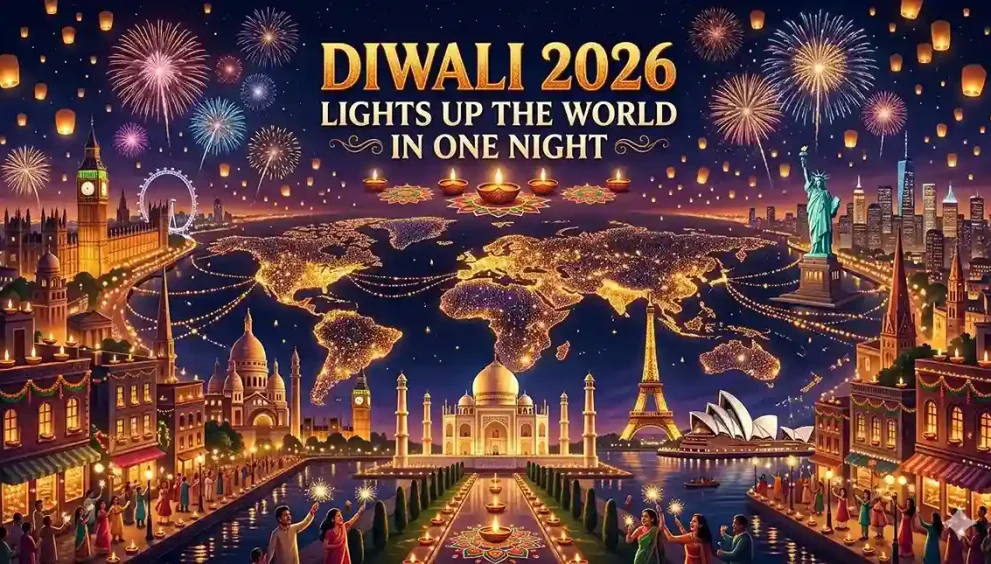
Diwali 2026 Lights Up the World in One Night
GLOBAL REPORT, November 8, 2026 — When the sun sets today over the Arabian Sea and the subcontinent slips into its darkest new-moon night of the year, something extraordinary happens simultaneously across six continents and more than 150 countries. From apartment windows in New Jersey to temple courtyards in Durban, from gleaming skyscrapers in Dubai to Victorian terrace houses in Leicester, from the tropics of Suriname to the southern latitudes of Melbourne — a billion-year-old human ritual repeats itself: someone reaches for a clay lamp, touches a flame to a cotton wick soaked in mustard oil, and sets it down in the dark.
Diwali 2026 — the Festival of Lights, Deepavali, the most widely celebrated Hindu festival on Earth — falls on Sunday, November 8, 2026, observed by an estimated one billion people worldwide on the Amavasya (new moon) night of the Hindu lunar month of Kartika.
Diwali symbolises the spiritual victory of Dharma over Adharma, light over darkness, good over evil, and knowledge over ignorance. For the world’s Hindu, Sikh, and Jain communities — and increasingly for non-Indian neighbours, colleagues, and friends touched by the festival’s warmth — November 8, 2026 is simply the night the world lights up.
But beyond the diyas and the fireworks, beyond the sweets and the Lakshmi puja, lies a demographic and cultural story of remarkable scale. According to the Ministry of External Affairs report updated in November 2024, there are 35.4 million non-resident Indians (NRIs) and People of Indian Origin (PIOs) residing outside India — the world’s largest diaspora. Every year, Diwali is their shared calendar moment — the one night when geography becomes irrelevant and the Indian-origin world coheres, briefly, into a single community of light.
This is WorldReport.press’s comprehensive global report on Diwali 2026 — what it means, where it is happening, and why its reach continues to grow.
By the Numbers: A Festival Without Equal
Before examining how the world celebrates, it is worth appreciating the sheer scale of what Diwali 2026 represents globally:
| Metric | Figure |
|---|---|
| Global Indian diaspora | 35.4 million NRIs & PIOs |
| Countries with Indian diaspora | 150+ |
| Countries where Diwali is a public holiday | 13 nations + 3 US states |
| Estimated global observers | ~1 billion (Hindu, Sikh, Jain) |
| Festival duration | Five days (November 6–10, 2026) |
| Main celebration | Sunday, November 8, 2026 |
| Lakshmi Puja Muhurat | 6:27 PM – 8:27 PM IST |
| Amavasya Tithi begins | 11:27 AM, November 8 IST |
The main day of the festival of Diwali — the day of Lakshmi Puja — is an official holiday in Fiji, Guyana, India, Malaysia, Mauritius, Myanmar, Nepal, Pakistan, Singapore, Sri Lanka, Suriname, and Trinidad and Tobago, and the US states of Connecticut, Pennsylvania, and California. No other Hindu festival can claim that breadth of formal, state-level recognition across so many sovereign nations.
The Five Days of Diwali 2026: A Festival Architecture
In most of India, Diwali is a five-day event, with the “main day” of Diwali falling in the middle of the festival. The first day of Diwali — Dhanteras — is considered an auspicious day for wealth and prosperity.
The 2026 five-day schedule runs as follows:
Day 1 — Dhanteras: Friday, November 6, 2026 The festival opens with Dhanteras, the auspicious occasion for purchasing gold, silver, and metal goods. Diaspora families mark Dhanteras with purchases of gold, utensils or symbolic items representing prosperity. Temples and associations conduct small ceremonies, and the day sets the tone for the Diwali celebrations to come.
Day 2 — Naraka Chaturdashi (Choti Diwali): Saturday, November 7, 2026 The day before the main celebration. In South Indian communities — the Tamil diaspora in Singapore, Malaysia, and South Africa; the Telugu communities in the USA and UK — this day is the primary Deepavali celebration, associated with Lord Krishna’s victory over the demon Narakasura. Families bathe before dawn, wear new clothes, and burst firecrackers at sunrise.
Day 3 — Lakshmi Puja (Main Diwali): Sunday, November 8, 2026 The apex of the festival. The most auspicious time for Lakshmi Puja in 2026 falls between 6:27 PM and 8:27 PM IST — a two-hour window considered ideal for worship of Goddess Lakshmi for wealth and prosperity. Across the globe, Hindu families perform Lakshmi-Ganesha puja, light diyas, burst fireworks, and exchange sweets.
Day 4 — Govardhan Puja / Gujarati New Year: Monday, November 9, 2026 Diwali also marks the commencement of a new year in western states such as Gujarat and certain northern places in India. For the substantial Gujarati diaspora — among the most economically significant Indian communities in the UK, USA, and East Africa — this day carries the added weight of New Year’s celebration. Business ledgers (bahi-khatas) are opened, prayers offered to Goddess Saraswati and Goddess Lakshmi, and new accounts commenced.
Day 5 — Bhai Dooj: Tuesday, November 10, 2026 The festival concludes with Bhai Dooj, celebrating the bond between brothers and sisters. A day celebrating sibling bonds. Indian families abroad keep the tradition alive through video calls, home celebrations and cultural events. It reinforces emotional ties stretched across continents.
The Spiritual Architecture of Diwali: Why One Festival Has Many Meanings
One of Diwali’s most striking features — and perhaps the key to its universal appeal — is that it carries different sacred meanings for different communities, yet all of them converge on the same symbolic core.
For Hindus, Diwali marks the end of a 14-year war in which the exiled Prince Rama of Ayodhya returns victorious, with the people lighting lamps along the path of darkness to light his way. For the Sikhs, this holiday represents freedom, marking the release of imprisoned Guru Hargobind from the designs of Emperor Jahangir; the guru refused his release until all 52 princes imprisoned with him were freed. For the Jains, Diwali marks the last of the great spiritual leaders, Lord Mahavira, who attained nirvana, also known as complete knowledge and enlightenment.
The festival of Deepavali is observed with equal warmth by Hindus, Sikhs, and Jains for different reasons, although the main theme which remains throughout is the triumph of light over darkness and good over evil.
This plurality of meaning — one festival, many sacred stories, one symbolic truth — helps explain why Diwali travels so well across cultures, languages, and generations of diaspora life.
United States: From Unofficial Holiday to Official Recognition
The main day of Diwali is an official holiday in the US states of Connecticut, Pennsylvania, and California — a development that would have seemed inconceivable to first-generation Indian immigrants of the 1970s and 1980s, who celebrated in private, their festival invisible to the mainstream.
That invisibility is now decisively gone. Hindu temples across America — the ISKCON network in New York, Los Angeles, Chicago, Houston, and more than 50 other cities; the Sri Venkateswara Temple in Pittsburgh; the Meenakshi Temple in Houston; the Hindu Temple of Atlanta — host Lakshmi puja programs drawing thousands. Community melas organized by Indian cultural associations fill convention centres and civic halls across Edison NJ, Fremont CA, Sugar Land TX, Schaumburg IL, and Herndon VA.
Hindu temples across America organize special Lakshmi pujas, where devotees gather for prayers, bhajans, and aarti. Homes are decorated with diyas and rangoli, and families prepare traditional sweets like ladoos, barfi, and jalebis. Many American schools with significant Indian populations now recognize Diwali, educating students about its cultural and spiritual significance.
The political recognition of Diwali in America has also accelerated. Since 2007, the US House of Representatives has passed resolutions recognizing Diwali. The White House has hosted Diwali celebrations under multiple presidential administrations. In New York City — home to one of the largest Indian populations in the Western Hemisphere — Diwali melas in Jackson Heights and cultural events in Manhattan’s Times Square draw tens of thousands.
For the approximately 4.4 million Indian-Americans, Diwali 2026 falls on a Sunday — allowing families to celebrate fully without the tension of work and school schedules that can complicate weekday observances. Community organizers expect 2026 to be among the most extensively celebrated Diwali years in American history.
United Kingdom: From Private Festival to National Celebration
In the United Kingdom, Diwali’s transformation from a minority community observance into a mainstream cultural event has been even more dramatic. The city of Leicester hosts what is routinely described as the largest Diwali celebration outside India — a claim supported by annual crowd estimates exceeding 35,000 for the Golden Mile light-switch-on ceremony, where the two-mile stretch of Belgrave Road is illuminated in a display that has become one of Britain’s most distinctive urban festivals.
London’s Trafalgar Square — home to the New Year’s countdown, the Pride parade, and major state ceremonies — hosts the official London Diwali celebration, organized by the Mayor of London’s office in partnership with Hindu, Sikh, and Jain community organizations. The event draws crowds of 35,000–40,000, with Bollywood performances, rangoli demonstrations, and a diya-lighting ceremony against the backdrop of Nelson’s Column.
The United Kingdom has one of the largest Indian diaspora populations in Europe, with Diwali firmly established as a mainstream cultural celebration. Birmingham, Bradford, Harrow, Wembley, Southall, and Wolverhampton all host significant Diwali events. The BAPS Swaminarayan Mandir in Neasden — the largest Hindu temple outside India — is among the most prominent venues for formal Lakshmi puja celebrations.
British schools increasingly incorporate Diwali education into their curricula, with Diwali now taught as a significant world festival in primary schools across England. Major British retailers — from supermarkets to department stores — have for years stocked Diwali gift items and sweets, marking the festival’s full integration into British commercial life.
Canada: The Mosaic of Light
Canada’s official policy of multiculturalism has created conditions particularly favourable to diaspora festival life, and Diwali reflects this. With approximately 1.8 million persons of Indian heritage — concentrated in the Greater Toronto Area, Vancouver, Calgary, Edmonton, and Ottawa — Canada’s Diwali celebrations are among the most elaborate in the Western world.
The City of Mississauga and the City of Brampton — which together form the geographic heart of Canada’s South Asian diaspora — host large Diwali melas drawing tens of thousands. In Vancouver, the Diwali celebrations on Main Street in the South Asian cultural district have become a fixture of the city’s autumn cultural calendar. The Parliament of Canada has formally recognized Diwali, and multiple provincial legislatures have passed Diwali recognition resolutions.
Indian-Canadian families observe Diwali with a combination of temple attendance (at the Swaminarayan Mandir Toronto, the Hindu Sabha Mandir in Brampton, and numerous other temples) and community melas, while also streaming live Lakshmi puja from major Indian temples via YouTube and temple apps.
Australia and New Zealand: The Southern Hemisphere Celebrates
In Australia, Diwali has undergone a rapid transformation in visibility and scale as Indian migration has surged in the 21st century. With over 800,000 Indian-origin residents, Australia’s Diwali celebrations have moved from temple courtyards to public spaces.
The Federation Square Diwali in Melbourne and the Darling Harbour Diwali in Sydney are among the most prominent, drawing diverse Australian crowds alongside the Indian community. Indian-Australian families light diyas, perform Lakshmi puja at home, and attend community events organized by local Indian associations and temples including the Shiva Vishnu Temple in Carrum Downs — one of the largest Hindu temples in the Southern Hemisphere.
In New Zealand, Diwali celebrations in Auckland’s Aotea Square have become one of the city’s major public festivals, reflecting the growth of the Indian-origin community in New Zealand’s largest city.
The Gulf: Diwali Under the Desert Sky
No accounting of global Diwali is complete without the Gulf, where over 3.5 million Indians form the backbone of economies across the UAE, Saudi Arabia, Kuwait, Qatar, Bahrain, and Oman.
In Dubai, Abu Dhabi, and Sharjah — cities where Indian shops, restaurants, and residential neighbourhoods have existed for generations — Diwali brings out public celebrations with a characteristic Gulf adaptation: fireworks are limited (and regulated), but public illuminations, community events in hotel ballrooms, Indian mall decorations, and temple programs make the festival unmistakable.
The Indian community in the Gulf faces a particular Diwali dynamic: many workers are separated from their families in India for the duration of the festival, and the occasion carries an emotional weight of longing alongside celebration. Temples including the ISKCON Dubai Temple serve a crucial social anchoring function — not just as religious spaces but as surrogate communities for workers far from home. Video calls and digital streaming of home pujas from India have become inseparable from Gulf Diwali observance.
South Asia’s Neighbourhood: Countries Where Diwali Is National Law
Although Diwali is largely an Indian festival, it is widely celebrated in other countries as well such as Malaysia, Sri Lanka, Singapore, Nepal, Myanmar, Mauritius and Fiji. In fact, Diwali is a national holiday in each of these countries.
Nepal: Known locally as Tihar, Diwali is observed over five days with unique local traditions, including worship of crows, dogs, cows, and oxen on successive days before the main human celebration — a nature-venerating dimension of the festival rarely seen elsewhere.
Sri Lanka: Deepavali is a public holiday observed primarily by the Tamil Hindu population, with major celebrations in Colombo, Jaffna, and plantation districts.
Malaysia and Singapore: Both countries — home to substantial Tamil and South Indian Hindu communities — observe Deepavali as a public holiday. In Singapore, Little India transforms each year into a blaze of light installations, bazaars, and street decorations drawing visitors from across Southeast Asia.
Mauritius: Mauritius hosts the Aapravasi Ghat, the only UNESCO World Heritage Site to pay homage to the memory of indenture. The Indian Festivals of Maha Shivaratri, Diwali, Thaipusam, Ponggal, Ganesh Chaturthi and Ugadi are all National Holidays. With an Indian-origin majority population, Mauritius observes Diwali at a national scale, with island-wide illuminations and official state ceremonies.
Fiji: Around 40 percent of Fiji’s population is of Indian descent, celebrating Diwali with participation from non-Indian Fijians as well. Fiji’s Diwali has evolved into a genuinely inter-community celebration, with Fijian, Chinese-Fijian, and other communities joining Indian-origin Fijians in the observance.
Trinidad and Tobago, Guyana, and Suriname: The Caribbean and South American nations with substantial Indian-origin populations — descendants of indentured labourers brought by the British and Dutch in the 19th century — observe Diwali as a national public holiday. In Trinidad and Tobago, Diwali is a major public event with national lighting programs and widespread non-Indian participation, reflecting 175 years of Indo-Trinidadian cultural presence.
South Africa: Diwali and the Indian Diaspora’s Oldest Western Story
Durban, with the largest Indian population in South Africa, transforms into a city of lights during Diwali. The iconic Grey Street area and the Umgeni Road Temple precinct host grand celebrations. Temples organize free meals (langar), cultural programs, and religious ceremonies attended by thousands. Johannesburg and Pretoria’s Hindu communities celebrate with public events, temple pujas, and community gatherings. The Indian diaspora has successfully maintained language, cuisine, and religious practices across generations, with Diwali being the most significant celebration.
South Africa’s Indian community — whose ancestors arrived as indentured labourers from 1860 — holds a particular historical distinction: it is the community in which Mahatma Gandhi developed his philosophy of Satyagraha, and in which his encounter with Indian diaspora conditions helped shape the global independence movement. For this community, Diwali is not just a religious festival but a testimony to 160 years of cultural resilience.
The Americas Beyond the USA: From Toronto to Suriname
The Indian diaspora’s presence in the Americas extends far beyond the United States and Canada. In the Caribbean — Guyana, Trinidad and Tobago, Jamaica, and Suriname — Indian-origin communities that have been present for more than a century observe Diwali with deep local traditions.
In Guyana, where persons of Indian descent constitute approximately 40 percent of the population, Diwali is a national public holiday and a pan-community celebration. In Suriname — once Dutch Guiana — the Hindustani community (descendants of indentured labourers from Bihar and Uttar Pradesh) maintains elaborate Diwali traditions, observing the festival in Hindi, Dutch, and Sarnami Hindustani. In Trinidad and Tobago, the National Council of Indian Culture organizes the National Diwali Motorcade — a massive public procession of decorated vehicles and performers that has no direct parallel anywhere else in the diaspora world.
Europe: A Festival Gaining Ground
Beyond the UK, Diwali celebrations are visible and growing across continental Europe. Indian communities in the Netherlands, Germany, France, Switzerland, Belgium, and the Scandinavian countries — smaller in absolute numbers than UK, USA, or Gulf populations but rapidly growing — organize Diwali events through local Hindu mandirs and cultural associations.
Amsterdam hosts Diwali celebrations at the Shree Ram Mandir and through the local Indian community association network. Frankfurt and Düsseldorf, homes to Germany’s largest Indian-origin communities, organize Diwali melas. Paris’s Indian community centres in the 10th arrondissement — concentrated around La Chapelle — mark Diwali with community events.
A notable European trend: Diwali has attracted non-Indian participants at rates higher than many other diaspora festivals, particularly among younger Europeans drawn to the aesthetic dimensions of the celebration — the diya lighting, the rangoli art, the fireworks — as well as the universal themes of light and renewal.
Diwali Goes Mainstream: The Festival’s Cultural Cross-Over
One of the most significant Diwali stories of the 2020s is not what happens in Indian-origin communities, but what happens beyond them.
In the United States, major retailers including Target, Walmart, and Amazon now stock dedicated Diwali sections. Hallmark and other greeting card companies produce Diwali cards. Major technology companies — Google, Microsoft, Salesforce — hold internal Diwali celebrations. Several US states beyond Connecticut, Pennsylvania, and California are advancing Diwali holiday legislation.
In the United Kingdom, Diwali is now taught in primary school curricula nationwide as a world religion festival. Major supermarket chains stock mithai and diya kits. The BBC, ITV, and Channel 4 air Diwali programming. The Prime Minister’s official residence at 10 Downing Street has hosted Diwali receptions under multiple governments.
This cultural crossover reflects something deeper than commercial opportunism. The core themes of Diwali — light over darkness, good over evil, knowledge over ignorance — are, as scholars of religion note, among the most universally appealing in human moral thought. They require no translation.
Regional Variations: How Diwali Differs Across the Subcontinent and the Diaspora
Diwali’s global celebrations are not a monolithic event — they reflect India’s own extraordinary regional diversity.
In North India (Uttar Pradesh, Delhi, Punjab, Rajasthan, etc.), Diwali is strongly linked to the Ramayana story of Lord Rama, Sita and Lakshmana returning to Ayodhya after 14 years of exile and the defeat of Ravana. People light rows of diyas to welcome Rama and celebrate the victory of dharma. In parts of South India, Diwali (often called Deepavali) is associated with the victory of Krishna over the demon Narakasura or other regional legends.
For the Gujarati diaspora — one of the most commercially and culturally prominent Indian communities in the UK, USA, East Africa, and Southeast Asia — Diwali coincides with New Year. Diwali evening’s Lakshmi puja is followed by New Year’s morning Govardhan Puja celebrations, with new business accounts opened and prayers offered for prosperity in the year ahead.
For the Bengali Hindu diaspora — concentrated in Kolkata, West Bengal, and the Bengali communities in London, New York, and Toronto — the Diwali night is associated with the worship of Goddess Kali rather than Lakshmi, giving the festival a different devotional character while maintaining the shared symbolic framework of light.
For the Punjabi Sikh diaspora — among the largest Indian-origin communities in the UK, Canada, and parts of the USA — Diwali is observed alongside Bandi Chhor Divas, the day commemorating Guru Hargobind’s release from Mughal imprisonment. Sikh gurdwaras worldwide are illuminated, and the Golden Temple in Amritsar blazes in lights that are visible across the city.
The Economics of Diwali: A Festival that Moves Markets
Diwali’s economic dimensions have grown alongside its cultural footprint. In India alone, Diwali season consumer spending — on gold, electronics, clothing, sweets, crackers, and home goods — runs into hundreds of billions of rupees annually, representing one of the largest seasonal retail surges in the global economy.
For the diaspora, Diwali triggers a distinctive pattern of transnational economic activity: NRIs transfer money home to families in India for Diwali shopping; they book international flights to India for the occasion (making October–November one of the busiest airline seasons on India routes); they purchase gold jewellery both locally and for family members in India; and they spend significantly on community events, temple donations, and catering.
In the UK, the “Diwali economy” — encompassing sweets, clothing, fireworks, decorations, and event spending — is estimated by industry analysts at hundreds of millions of pounds annually. In the USA, Diwali-related consumer spending has attracted the attention of major brands, with dedicated Diwali marketing campaigns now standard practice for companies targeting the Indian-American market.
Digital Diwali: Technology and the Festival of the 21st Century
Perhaps no aspect of NRI Diwali observance has changed more dramatically in recent years than the digital dimension. What was once a private, community-confined celebration is now a globally visible, digitally networked event.
Major Indian temples — from the Laxminarayan Temple in Delhi to the Sri Padmanabhaswamy Temple in Thiruvananthapuram — stream live Lakshmi puja on Diwali night, attracting NRI viewers in the hundreds of thousands across global time zones. Online puja booking platforms allow diaspora Hindus to commission named sevas at temples across India, receiving prasad by international mail.
Sharing culture: Many diaspora families use Diwali as a chance to explain Hindu traditions to neighbours, colleagues, and school friends. In this way, Diwali 2026 becomes not only a festival of light for the Hindu community, but also a moment of cultural exchange and mutual understanding wherever it is celebrated.
Social media has amplified Diwali’s global visibility to an unprecedented degree. Instagram, TikTok, and YouTube fill each November with diya-lighting videos, rangoli tutorials, mithai recipes, and Diwali home decoration walkthroughs — generating millions of views from non-Indian audiences discovering the festival through their feeds. Diwali consistently trends globally on X (formerly Twitter) each year, a real-time map of the festival’s geographic reach.
Fireworks and the Environment: A Diwali Tension
No global report on Diwali 2026 would be complete without acknowledging the tensions around fireworks and environmental impact — one of the most contested dimensions of contemporary Diwali observance, both in India and the diaspora.
In India, major cities including Delhi — where air quality in November is already severely stressed by agricultural stubble burning and winter inversion conditions — have seen repeated debates and legal battles over fireworks restrictions. The Supreme Court of India has periodically imposed fireworks limitations, while courts in several states have regulated the hours and types of permissible crackers.
In the diaspora, fireworks regulations vary widely. Many NRI community events operate under local authority fireworks permits, and public displays have largely replaced private cracker-bursting in urban settings. Community leaders and Hindu organizations in multiple countries have actively promoted “green Diwali” messaging — encouraging diyas over crackers, electric lights, and community clean-up initiatives following celebrations.
The tension between tradition and environmental responsibility is not unique to Diwali — it mirrors debates around fireworks at Bonfire Night, Chinese New Year, and New Year’s Eve globally. For Hindu communities navigating this tension, the conversation is an active and ongoing one, with no settled consensus.
Diwali 2026: A Sunday of Particular Significance
In 2026, the government has designated the 8th as the calendar holiday for Diwali. The Sunday date is of particular practical significance for the diaspora: for the first time in several years, the main Diwali falls on a weekend day in most of the world, allowing NRI communities to celebrate fully — with temple visits, community events, late-night illuminations, and elaborate home pujas — without the constraint of next-morning work and school commitments.
Community event organizers in the USA, UK, Canada, and Australia have reported higher-than-usual bookings and attendance expectations for 2026, with the Sunday date driving extended celebrations through the weekend.
What Diwali 2026 Tells Us About the Indian Diaspora
Diwali’s global footprint in 2026 is more than a cultural curiosity — it is a data point about one of the most significant population movements in modern history. Every year, 2.5 million Indians emigrate overseas, making India the nation with the highest annual number of emigrants in the world.
Each wave of emigration carries Diwali further. Each generation of NRI children raised in diaspora communities makes a choice — whether to continue the festival or let it fade. The evidence of 2026 suggests, overwhelmingly, that they are choosing to continue — and to expand. Second-generation NRIs in the UK, USA, Canada, and Australia are not merely passively inheriting Diwali; they are actively organizing it, digitalizing it, explaining it to their non-Indian friends, and building community institutions around it.
Diwali is the biggest festival for Indians around the world. Homes are lit with lamps, diaspora temples conduct Lakshmi Puja, and community centres organise large Diwali melas. For migrants, Diwali carries deep nostalgia, a reminder that light can be created anywhere, even when far from home.
That last phrase is perhaps the truest thing about global Diwali 2026. Light can be created anywhere. The clay lamp does not require the Ganges. The rangoli can be drawn on a London pavement, a Canadian driveway, a Dubai apartment balcony. The Lakshmi puja can be performed facing east in a New Jersey living room or a Sydney terrace. What is required is not a specific geography, but a specific intention: to hold the light against the dark, to remember that good can triumph over evil, to say — in Sanskrit or in Tamil or in Bhojpuri or in the silence of a single diya flame set on a windowsill in the middle of November — that we are still here, still faithful, still alight.
On November 8, 2026, 35 million voices say exactly that.
Key Facts: Diwali 2026 at a Glance
| Category | Detail |
|---|---|
| Main Date | Sunday, November 8, 2026 |
| Festival Name | Diwali / Deepavali / Divali |
| Tithi | Kartika Amavasya (New Moon) |
| Amavasya Begins | 11:27 AM, November 8 (IST) |
| Amavasya Ends | 12:31 PM, November 9 (IST) |
| Lakshmi Puja Muhurat | 6:27 PM – 8:27 PM, November 8 (IST) |
| Dhanteras | Friday, November 6, 2026 |
| Choti Diwali | Saturday, November 7, 2026 |
| Govardhan Puja / Gujarati New Year | Monday, November 9, 2026 |
| Bhai Dooj | Tuesday, November 10, 2026 |
| Public Holiday Countries | 13 nations + Connecticut, Pennsylvania, California (USA) |
| Global NRI/PIO Population | 35.4 million |
| Faiths Observing | Hindu, Sikh, Jain (+ secular observers) |
Global Time Zone Guide: When to Celebrate Diwali Lakshmi Puja
| Region | Local Time for Lakshmi Puja Window |
|---|---|
| India (IST) | 6:27 PM – 8:27 PM, November 8 |
| UAE / Gulf (GST) | 4:57 PM – 6:57 PM, November 8 |
| UK (GMT) | 12:57 PM – 2:57 PM, November 8 |
| USA — East Coast (EST) | 7:57 AM – 9:57 AM, November 8 |
| USA — West Coast (PST) | 4:57 AM – 6:57 AM, November 8 |
| Canada — Toronto (EST) | 7:57 AM – 9:57 AM, November 8 |
| Australia — Sydney (AEDT) | 11:57 PM – 1:57 AM, November 8–9 |
| Singapore (SGT) | 8:57 PM – 10:57 PM, November 8 |
| South Africa (SAST) | 2:57 PM – 4:57 PM, November 8 |
Times are approximate conversions from IST. Consult local panchang for precise regional timings.