

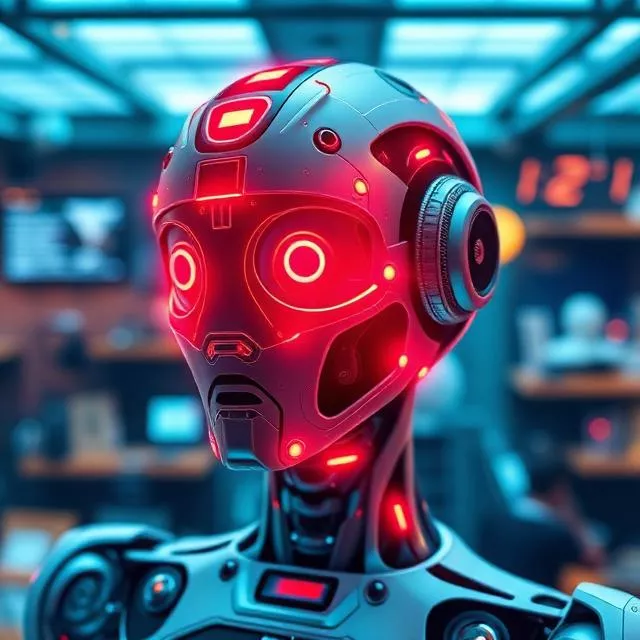


The Future of Wars: How AI, Cyber Attacks, and Quantum Technology


The Future of Wars: How AI, Cyber Attacks, and Quantum Technology
Published: December 31, 2025
Category: Global Security | Technology | Defense
Website: www.worldreport.press
Introduction: The Silent Revolution in Modern Warfare
Imagine a major city plunged into darkness—not by bombs, but by a cyber attack executed thousands of miles away. Autonomous drone swarms neutralize defenses with precision guided by AI algorithms faster than any human commander. Meanwhile, quantum computers silently decrypt secrets once thought unbreakable, shifting global power overnight.
This is the future of warfare in 2025—a world where AI, cyber attacks, and quantum technology converge, creating conflicts that are faster, more invisible, and potentially more devastating than anything in history. Traditional boundaries between peace and war, attacker and defender, battlefield and homeland are blurring.
Hybrid warfare, combining kinetic force with digital disruption, is now the norm. This report explores how different countries are adapting, the risks posed, and strategies to prevent catastrophic escalation.
Artificial Intelligence: The New General on the Battlefield
AI is becoming the central nervous system of modern militaries:
- United States: Project Maven and DARPA initiatives leverage AI for drone targeting, predictive analytics, and logistics optimization. AI shortens decision cycles from hours to seconds.
- China: Focusing on “intelligentized warfare,” AI-guided systems enhance missile defense, autonomous drones, and command strategies.
- Russia: Investing in swarm robotics and autonomous artillery platforms to compensate for conventional force limitations.
- Israel: Leading in autonomous UAV operations and AI-driven border defense systems.
Key Threats:
- Lethal Autonomous Weapon Systems (LAWS) capable of striking without human oversight
- AI misjudgment leading to accidental escalation
- Rapid retaliation loops accelerating conflicts
AI is also transforming intelligence gathering, supply chain optimization, and predictive modeling. Nations with superior AI integration may dominate conflicts before traditional forces even mobilize.
Cyber Attacks: The Fifth Domain of Warfare
Cyber operations have become a primary instrument of national power:
- United States & NATO: Offensive and defensive cyber commands actively probe adversaries’ networks.
- Russia: Uses cyber campaigns to disrupt energy grids, elections, and logistics in Eastern Europe.
- China: Engages in long-term cyber espionage targeting critical infrastructure worldwide.
- Iran & North Korea: Focus on asymmetric cyber attacks to offset conventional limitations.
Trends in 2025:
- AI-powered malware adapts in real-time
- Generative AI produces deepfakes to destabilize societies
- “Harvest now, decrypt later” strategies prepare for quantum-enabled decryption in the future
Cyber warfare lowers the threshold for conflict, enabling smaller nations or non-state actors to inflict disproportionate damage while keeping attribution uncertain.
Quantum Technology: Breaking the Unbreakable
Quantum computing poses a long-term strategic threat:
- United States: Aggressive push toward post-quantum cryptography (PQC) to safeguard communications
- China: Demonstrated quantum-secured satellite communications
- European Union: Investing heavily in quantum R&D for defense, sensing, and encrypted networks
Capabilities:
- Decrypting current encrypted communications
- Detecting stealth aircraft, submarines, and drones
- Securing command and control systems against interception
The first nation achieving large-scale quantum military advantage could dominate for decades, sparking a new arms race surpassing nuclear competition.
The Deadly Convergence: AI + Cyber + Quantum
When integrated, these technologies enable hyperwar—conflicts at speeds and scales beyond human comprehension:
- Scenario: AI orchestrates a cyber attack, quantum computers break encrypted defenses, while autonomous drones exploit chaos
- Impact: Decision loops compress from days to microseconds, increasing the risk of accidental escalation
- Disinformation & Cognitive Warfare: Deepfakes and AI-generated content destabilize societies before physical combat begins
Countries investing in multimodal warfare technologies—AI, cyber, and quantum—will gain decisive advantages.
Country-Wise Impact of Emerging Technologies
| Country | AI & Cyber Focus | Quantum Initiatives | Strategic Implications |
|---|---|---|---|
| USA | Autonomous drones, Project Maven | PQC migration, secure quantum networks | AI dominance, cyber deterrence |
| China | Swarm robotics, intelligentized warfare | Quantum satellite communications | Regional & global power projection |
| Russia | LAWS, cyber strikes | Quantum research for encryption | Asymmetric advantage, destabilization |
| Israel | Border defense drones, cybersecurity | Quantum sensing for military | Tactical superiority, rapid response |
| EU (Germany, France, UK) | Cyber defense, autonomous vehicles | Quantum encryption & sensors | Coordinated defense, tech parity |
| India | Drone surveillance, cybersecurity modernization | Early quantum R&D | Regional deterrence, emerging tech adoption |
| North Korea/Iran | Cyber asymmetric tactics | Minimal quantum deployment | Cost-effective disruption |
Ethical, Legal, and Strategic Challenges
- Accountability: Who is responsible for civilian casualties from AI weapons?
- Deterrence: Cyber attacks are difficult to attribute and escalate rapidly
- Quantum Arms Race: Coordinated global standards remain absent
International law, AI safety protocols, and cyber norms lag behind technological advancement, increasing risk.
Preparing for the New Era of Warfare
Nations are responding by:
- Creating Cyber Command structures (US, NATO)
- Investing in resilient, air-gapped infrastructure
- Developing ethical AI frameworks and quantum-resistant encryption
- Emphasizing human-machine teaming for decision oversight
Leaders and laggards will face stark differences in security posture.
Conclusion: A Fork in the Road
AI, cyber operations, and quantum technology have transformed the nature of global conflict. They offer precision and deterrence but also risk uncontrollable escalation.
As 2025 ends, humanity faces a choice:
- Cooperation & norms: Establish treaties, PQC standards, and AI safety protocols
- Arms race & vulnerability: Risk perpetual insecurity and digital-first wars
The next conflict may not start with a declaration—it may begin with a power outage, a decrypted secret, or an algorithmic decision.

