



Nigerian Freelancers: Local vs Global Income Debate

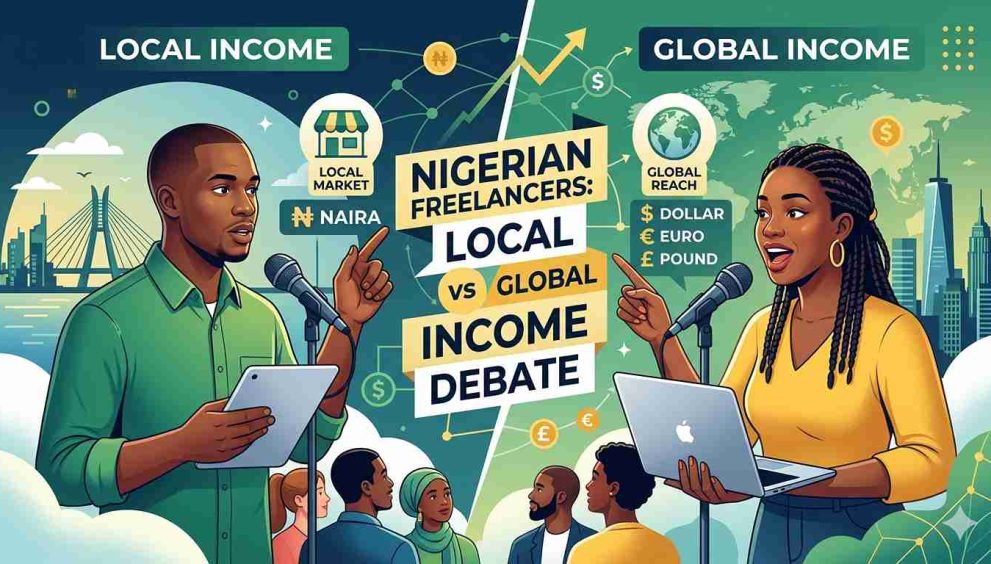
A heated discussion has erupted among Nigerian tech freelancers over the best path to sustainable income in 2026: chasing high-paying dollar gigs from international clients or building volume through local small business projects.
The debate gained traction after UxUi Tega, a prominent voice in Nigerian design and tech circles, advised freelancers struggling to earn $5,000 per month (roughly ₦6.9 million at current exchange rates) to “quit and go farm.” Technical Ben fired back with an ambitious local strategy: charging ₦50,000 per website for small businesses, scaling to serve 2,000 clients, and targeting ₦100 million in revenue with a small team plus monthly retainers.
The exchange highlights deeper frustrations in Nigeria’s growing freelance economy — intense competition, client challenges, AI disruption, and the eternal pull between quick local naira jobs and competitive global opportunities.
The Spark: “If You Can’t Hit $5k, Go Farm”
UxUi Tega’s blunt comment struck a nerve. Many Nigerian freelancers, especially in UI/UX design, web development, graphic design, and content creation, face pressure to deliver dollar-level earnings while battling local economic realities.
Critics of the international route point to:
- Fierce global competition on platforms like Upwork and Fiverr
- Payment hurdles and high withdrawal fees
- Time zone differences and demanding clients
Tega’s message: If consistent high earnings in dollars remain elusive after serious effort, it may be wiser to pivot to more stable (if less glamorous) local ventures like agriculture.
The Counter: Build Big with Local Volume
Technical Ben rejected the defeatist tone. Instead, he outlined a scalable local model:
- Charge ₦50,000 per basic website for small Nigerian businesses (restaurants, salons, boutiques, retailers, etc.)
- Target 2,000 clients — ambitious but theoretically possible given Nigeria’s massive MSME sector
- Add monthly retainers for maintenance, updates, and digital marketing
- Hire a small team to handle delivery while focusing on sales and client acquisition
At scale, this could generate significant naira revenue without the stress of international pitching or currency conversion issues. Ben emphasized that Nigeria has over 40 million micro, small, and medium enterprises (MSMEs), the vast majority of which remain digitally underserved — many still lack professional websites, social media presence, or basic online tools.
Harsh Realities Raised by Critics
The discussion quickly moved beyond optimism. Several freelancers highlighted practical challenges with the local volume approach:
- Burnout risk: Landing and delivering 2,000 projects (even with a team) requires massive sales effort, project management, and quality control.
- Low 2026 rates: AI tools like ChatGPT, Midjourney, and website builders (e.g., Framer, Dora) are driving down prices for basic services. What once fetched ₦100,000+ now competes at ₦30,000–₦50,000.
- Client hassles: Nigerian small business clients are notorious for ghosting, endless revisions, late payments, and scope creep.
- Scaling math: Even at ₦50,000 per site, reaching 2,000 clients could take years. Factoring in marketing costs, team salaries, taxes, and non-paying clients, the path to ₦100 million net profit looks far longer and riskier than presented.
- Quality vs. quantity: Rushing low-budget projects can damage reputation and limit upward mobility.
Many participants noted that the most successful Nigerian freelancers combine both worlds — starting with local wins to build portfolios and cash flow, then transitioning to higher-paying international clients for better work-life balance and earnings stability.
The Bigger Picture: Nigeria’s Freelance and MSME Opportunity
Nigeria’s freelance sector continues to expand, fueled by a young, tech-savvy population and improving internet access. However, structural issues persist:
- Payment gateways and FX challenges for international earnings
- High competition in saturated niches (graphic design, basic web dev)
- Underserved local market: With approximately 39.6 million MSMEs, most operating informally and with limited digital adoption, genuine demand exists for affordable tech services.
The debate underscores a key strategic question for 2026: Should freelancers position themselves as premium global talent chasing dollars, or as efficient local service providers scaling volume in naira? Smart operators often recommend a hybrid model — secure local retainers for steady income while building skills and portfolios for selective high-value international work.
Lessons for Nigerian Tech Freelancers in 2026
- Specialize and upskill: Basic services face AI pressure. Focus on high-value areas like UI/UX strategy, conversion-focused web design, AI-integrated solutions, or niche digital marketing.
- Validate your model: Test small before scaling. Start with 10–20 local clients at ₦50,000+ before dreaming of 2,000.
- Protect yourself: Use clear contracts, milestone payments, and tools to manage revisions and scope.
- Diversify: Don’t put all eggs in one basket — blend local stability with selective global gigs.
- Mind the math: Revenue targets must account for taxes, overhead, non-payment risk, and personal burnout.
The conversation on platforms like Twitter/X, LinkedIn, and Nigerian tech WhatsApp groups reflects a maturing freelance community — one that is moving past hype toward realistic, sustainable strategies.
As Nigeria’s digital economy grows, the winners will likely be those who balance ambition with pragmatism: serving the massive local MSME base intelligently while keeping doors open to premium international opportunities.