



Global AI Usage by Country in 2026: Worldwide Adoption Rates, Top Models, Popular Use Cases & Regional Trends

By WorldReport Press Team | April 18, 2026
Artificial intelligence is transforming daily life, work, and economies across the planet. From bustling tech hubs in Singapore and the UAE to emerging markets in India and Brazil, millions of people worldwide now regularly use generative AI tools like ChatGPT, Google Gemini, Claude, Grok, and local alternatives.
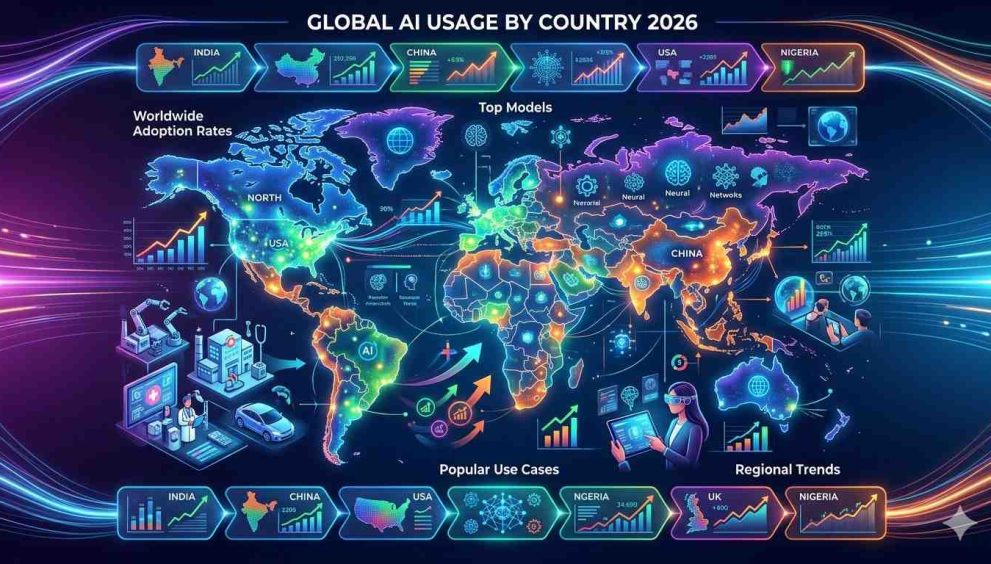
At WorldReport Press, we deliver clear, fact-based coverage of global technology trends. In 2026, AI adoption has reached historic speed — faster than the personal computer or the internet in their early days. This comprehensive report examines worldwide AI usage statistics, country-by-country adoption rates, the most popular AI models, real-world use cases, and key regional differences shaping the global AI landscape.
Global AI Adoption Overview in 2026
Generative AI has achieved remarkable penetration in just a few years:
- Global average: Around 16% of the world’s working-age population used generative AI tools in the second half of 2025, with continued growth into 2026.
- Regional divides: Adoption averages 24.7% in the Global North versus 14.1% in the Global South, though several developing nations show surprisingly high engagement.
- Population-level milestone: Generative AI reached roughly 53% adoption in some metrics within three years of mainstream availability.
- Business adoption: Organizational use of AI has surged, with many surveys showing 70–88% of companies integrating AI in at least one function.
Adoption correlates strongly with GDP per capita, digital infrastructure, education levels, and government AI strategies. However, outliers like the UAE and Singapore demonstrate that proactive policy and investment can drive exceptionally high usage.
Top Countries by AI Adoption Rates (Working-Age Population)
Here are the leading countries based on the latest available global data (primarily H2 2025 figures with ongoing growth trends into 2026):
- United Arab Emirates (UAE) — 64.0% (highest globally, up 4.6 percentage points)
- Singapore — 60.9% (strong government push and digital infrastructure)
- Norway — 46.4%
- Ireland — 44.6%
- France — 44.0%
- Spain — 41.8%
- New Zealand — 40.5%
- Netherlands — 38.9%
- United Kingdom — 38.9%
- Qatar — 38.3%
Other notable performers include South Korea, Australia, and several European nations. The United States ranks around 24th in some adoption metrics (approximately 28–45% depending on the survey), despite leading in AI model development and investment. In contrast, India shows extremely high usage in certain studies (up to 73–92% in employee or surveyed populations), driven by cost-effective access and practical applications.
Regional Highlights:
- North America: Strong overall (~31.65% average in some reports), led by the U.S. and Canada.
- Europe: Solid adoption (around 27%), with Nordic and Western European countries leading.
- Middle East: High rates thanks to UAE, Qatar, and Saudi Arabia’s AI initiatives.
- Asia-Pacific: Mixed but dynamic — Singapore and South Korea excel; India and parts of Southeast Asia show rapid consumer growth.
- Latin America & Global South: Lower averages but fast growth in countries like Brazil.
Most Popular AI Models Worldwide in 2026
ChatGPT remains the dominant force globally:
- ChatGPT (OpenAI): Leads with massive market share (around 60%+ of consumer traffic) and over 900 million weekly active users. It accounts for a large portion of global AI web visits.
- Google Gemini: Strong second place (~21.5% market share), with approximately 450 million monthly users. Popular due to integration with Google services and multilingual capabilities.
- DeepSeek (China): Rising fast, especially in Asia, with strong performance in coding and technical tasks.
- Grok (xAI): Gaining traction for its real-time knowledge and less restricted style.
- Claude (Anthropic): Favored for detailed, thoughtful responses and professional use (around 2% share but high loyalty).
- Others: Microsoft Copilot, local Chinese models (e.g., Qwen), and region-specific tools.
Many users worldwide now combine 2–3 models depending on the task. In China and parts of Asia, domestic models see heavy usage due to accessibility and data preferences.
ChatGPT User Distribution (Top Countries by Traffic/Users):
- United States (~15–19% of global traffic, ~205 million users)
- India (~9.5%, ~198 million users)
- Brazil, Canada, France, and others follow.
Common AI Use Cases Around the World
How people use AI varies by region, economy, and needs:
Universal Use Cases:
- Research and information synthesis
- Writing assistance (emails, reports, social media)
- Idea generation and brainstorming
- Coding, debugging, and technical problem-solving
- Personal productivity (travel planning, shopping, learning)
Regional Variations:
- India and parts of Asia: Heavy focus on coding, education, and career assistance. Many students and young professionals use AI for skill development and job preparation.
- United States and Western Europe: Balanced use — professional tasks (content creation, data analysis), creative work, and personal finance/health advice.
- Middle East (UAE, Singapore): Enterprise and government applications, multilingual support, and innovation-driven tasks.
- Latin America (e.g., Brazil): Practical daily help, education, and small business tools.
Business use cases often include customer service automation, predictive analytics, and operational efficiency. In developing markets, AI helps bridge gaps in access to information and services.
Benefits, Challenges & Future Outlook
Benefits: Time savings, boosted productivity (14–26% gains reported in some roles), greater creativity, and economic value (e.g., $172 billion annually for U.S. consumers alone, with similar multipliers worldwide).
Challenges:
- Digital divide between high- and low-adoption countries
- Concerns over job displacement, accuracy, privacy, and bias
- Energy consumption and environmental impact of large models
- Regulatory differences across nations
Looking ahead, AI adoption is expected to accelerate further in 2026–2027, especially as costs drop and multimodal tools (text + image + video) improve. Emerging economies could see the fastest relative growth if infrastructure and affordable access expand.
The Global AI Picture: Innovation vs. Adoption
While the United States and China dominate AI model development, investment, and research, adoption leaders often include smaller, agile nations with strong digital policies (UAE, Singapore). This highlights an important distinction: building AI versus using it in everyday life.
What do you think? Which country’s AI adoption story surprises you most? Are you using ChatGPT, Gemini, Claude, or a local model? Share your experiences and country in the comments below — from the UAE to India, the US to Brazil, or anywhere in between.
Stay informed with WorldReport Press. Subscribe for ongoing coverage of global AI trends, technology policy, innovation, and what it means for economies and societies worldwide. Share this report if you found it useful.