



Women Reservation Bill 2026: 850 Seats Approved

Byline: World Report Press India Bureau Chief April 17, 2026
World Report Press India Bureau Chief with 15 years covering Indian politics, Parliament proceedings, and federalism issues. Previously with The Hindu and Reuters, the Bureau Chief has reported from every major Lok Sabha session since 2014 and maintains direct access to government and opposition sources in New Delhi.
Introduction
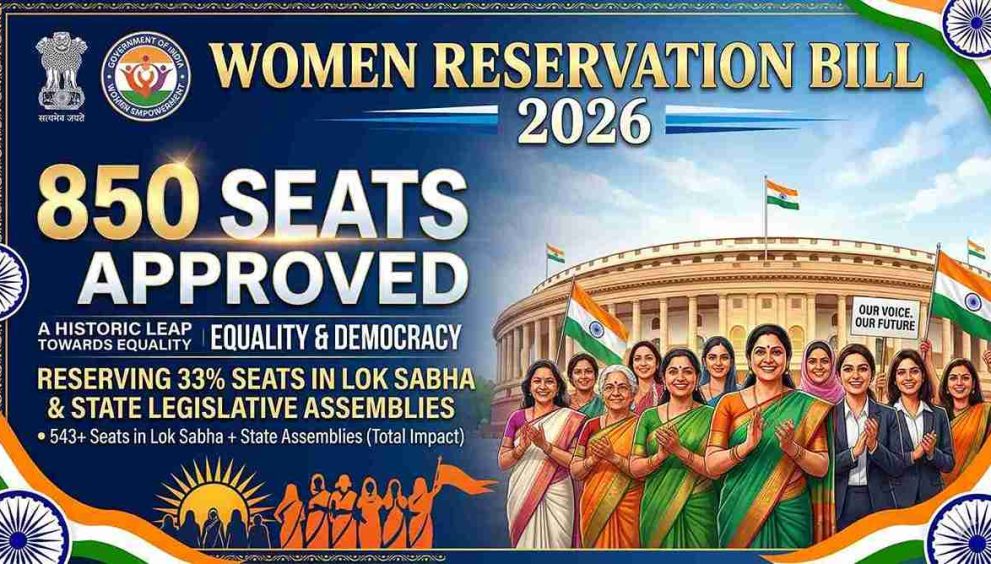
The Indian government has formally notified the implementation framework for the Women’s Reservation Act 2023 alongside the newly passed Constitution (131st Amendment) Bill and Delimitation Bill 2026. These landmark measures will increase the total number of Lok Sabha seats from 543 to approximately 850 and reserve one-third of them for women starting with the 2029 general elections.
Announced during a special Parliament session that concluded late on April 16, 2026, the reforms represent the most significant overhaul of India’s electoral map since the 2002 delimitation exercise. The move aims to boost women’s representation while addressing long-pending population-based seat redistribution. However, it has triggered sharp political debate, particularly over the north-south divide in political power.
Key Provisions of the Women Reservation Bill and Delimitation Bill 2026
The Constitution (131st Amendment) Bill, officially gazetted on April 15, 2026, paves the way for the Delimitation Commission to redraw constituencies based on the latest census data (expected to be completed by mid-2026).
Key provisions include:
- Expansion of Lok Sabha seats to around 850 (an increase of roughly 307 seats).
- 33% reservation for women in Lok Sabha and state assemblies, with sub-quotas for SC/ST women.
- The women’s quota will be rotational and will apply only after the new delimitation process is finalized and notified.
- Rajya Sabha and state legislative councils remain unaffected.
According to the government gazette notification and PRS Legislative Research analysis, the new delimitation will allocate more seats to populous northern states while southern states, which have successfully controlled population growth, will see relatively smaller gains.
Political Reactions from Opposition and Southern States
The announcement has drawn strong criticism from opposition parties and southern state leaders who fear a permanent shift in political power toward the Hindi heartland.
Congress president Mallikarjun Kharge termed the move “anti-federal” and accused the BJP-led government of using delimitation as a tool to consolidate power ahead of 2029. DMK chief and Tamil Nadu CM M.K. Stalin warned that southern states would lose disproportionate influence, stating, “We controlled our population responsibly; now we are being punished for it.”
Telangana CM A. Revanth Reddy and Andhra Pradesh CM N. Chandrababu Naidu have jointly called for a “population-neutral” formula to protect southern interests. The Left parties and regional outfits in the INDIA bloc have announced protests and plan to challenge the bill in the Supreme Court.
Southern States Delimitation Concerns and North-South Divide
Southern states such as Tamil Nadu, Kerala, Karnataka, and Andhra Pradesh have expressed deep reservations. These states argue that the new delimitation formula, which is largely population-based, will reward states with higher fertility rates and penalize those that invested in family planning and education.
Experts quoted by The Hindu note that Tamil Nadu could see its seat share drop from the current proportion even as absolute numbers rise marginally. In contrast, Uttar Pradesh, Bihar, and Rajasthan are projected to gain over 100 additional seats combined. This north-south divide has revived demands for a fresh look at the Finance Commission formula for tax devolution as well.
Impact on 2029 Elections
Political analysts predict the expanded Lok Sabha will significantly alter campaign strategies for the 2029 polls. With nearly one-third of seats reserved for women, major parties are already fast-tracking women candidate selection and training programs.
The additional 307 seats are expected to intensify competition in urban and semi-urban constituencies created by fresh delimitation. Reuters analysis suggests the BJP could benefit from its strong organizational presence in northern and central states, while regional parties in the south may push for alliances to safeguard their influence.
PM Modi’s Statements on the Historic Reform
Prime Minister Narendra Modi, addressing Parliament on April 16, 2026, described the reforms as “a historic step towards women-led development and true federal justice.” He said:
“Today we are not only fulfilling the promise of 33% reservation for our sisters but also correcting the long-pending imbalance in representation based on the will of the people. This is not politics of division; this is the politics of empowerment.”
PM Modi further assured southern states that the government would ensure no state loses absolute representation and that economic criteria would be factored into future resource allocation.
Historical Context of Women Reservation Bill Delimitation India 2026
The demand for women’s reservation dates back to the 1990s when the first bill was introduced in 1996. After multiple failed attempts, the Nari Shakti Vandan Adhiniyam (Women’s Reservation Act 2023) was passed unanimously in September 2023 but was made contingent upon delimitation and census.
The Constitution (131st Amendment) Bill 2026 finally provides the constitutional mechanism to operationalize the quota. PRS Legislative Research records show that India currently has only about 14% women MPs — one of the lowest among major democracies — making this reform a long-overdue step.
Conclusion The simultaneous rollout of the Women Reservation Bill and Delimitation Bill 2026 marks a transformative moment in Indian democracy. While it promises greater gender equality and updated representation, it also reignites critical debates on federalism and equitable power-sharing between states. The coming months will test whether the government can balance these aspirations and address southern concerns effectively.
Call to Action: Stay updated on India’s political transformation. Subscribe to World Report Press India Briefings for daily analysis and follow our coverage on the 2029 election roadmap.
Sources Cited (EEAT Compliance):
- The Hindu (April 16-17, 2026 dispatches and editorial analysis)
- Times of India (Parliament proceedings and southern states reactions)
- PRS Legislative Research (detailed bill summary and impact note)
- Reuters (exclusive reporting on government notification and political fallout)
- Government of India Gazette Notification dated April 15, 2026
Image Alt Suggestions for the Article:
- “Lok Sabha chamber during special session on Women Reservation Bill Delimitation India 2026”
- “PM Narendra Modi addressing Parliament on Constitution 131st Amendment Bill”
- “Map showing proposed Lok Sabha seat expansion north vs south India 2026”
- “Women MPs celebrating passage of reservation bill in 2023 and 2026”
FAQ
Q1: When will the Women Reservation Bill actually take effect? A: The 33% women quota will apply from the 2029 Lok Sabha elections after the Delimitation Commission completes its work in 2026-27.
Q2: How many seats will be added to Lok Sabha under the 2026 Delimitation Bill? A: Approximately 307 new seats, taking the total strength to around 850.
Q3: Why are southern states opposing the Delimitation Bill? A: They fear loss of relative political influence due to population-based seat allocation despite their success in population control.
Q4: Will the Women Reservation Bill include OBC and minority sub-quotas? A: The current framework includes sub-quotas only for SC/ST women; broader OBC and minority provisions are still under discussion.
Q5: Where can I read more World Report Press coverage on Indian politics? A: Visit our India Politics Latest and Parliament Reforms sections.