



US Job Losses 2026: Growth Slows Amid Iran Conflict

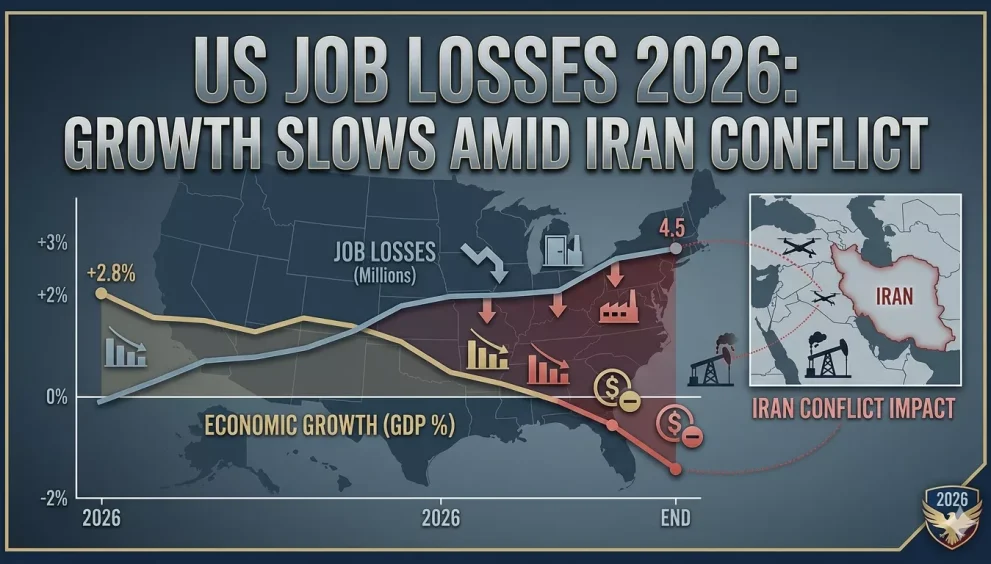
US Job Losses 2026: Growth Slows Amid Iran Conflict
By WorldReport.Press Team | March 27, 2026
The U.S. economy, long seen as a pillar of global stability, delivered a troubling surprise in early March 2026. Employers shed 92,000 jobs in February — a sharp contraction far worse than economists’ expectations of modest gains. The unemployment rate climbed to 4.4%, while previous months’ figures were revised downward. This unexpected weakness comes at a critical moment, as the ongoing U.S.-Israeli conflict with Iran disrupts global energy supplies and sends oil prices soaring.
The combination of softening U.S. data and the energy shock from the Strait of Hormuz is raising concerns about slower worldwide growth, higher inflation, and increased market volatility in 2026.
U.S. February 2026 Jobs Report: A Clear Miss
According to the U.S. Bureau of Labor Statistics, nonfarm payroll employment fell by 92,000 in February, missing forecasts of around +50,000 to +60,000 jobs. January’s gain was revised down to +126,000, and broader job losses affected nearly all major sectors, including health care (impacted by strikes), manufacturing, transportation, federal government, and information services.
- Unemployment rate: Rose to 4.4% from 4.3%.
- Wage growth: Average hourly earnings still increased 0.4% month-over-month and 3.8% year-over-year, offering some support to workers.
- Context: Analysts partly blamed severe winter weather and major strikes, but the scale of the decline has fueled worries of deeper underlying weakness.
This marks one of the weakest monthly readings since the pandemic period and adds to evidence that the U.S. economy entered 2026 with softer momentum than previously thought. Q4 2025 GDP growth was already revised lower to around 1.4%, and full-year 2026 forecasts have been tempered.
The Iran Conflict Amplifies Global Risks
The labor market softness coincides with major disruptions in the Middle East. Attacks on energy infrastructure and restricted shipping through the Strait of Hormuz — a chokepoint for roughly 20% of global oil and significant LNG volumes — have driven Brent crude prices sharply higher, often exceeding $100–$110 per barrel in volatile trading.
The energy shock is now rippling outward, creating a double challenge for the global economy: weaker demand signals from major economies combined with supply-side cost pressures.
Country-Wise and Regional Impacts
United States Higher energy costs act like a tax on consumers and businesses, potentially reducing spending and corporate profits. With gasoline prices approaching or exceeding $4 per gallon nationally, households face higher commuting, grocery, and goods costs. The Federal Reserve now faces a tougher balancing act — softer growth and labor market cooling may call for rate support, but rising inflation from oil could limit easing. Economists warn that sustained high oil prices could shave further points off already modest 2026 growth projections.
Europe Still recovering from the energy crisis triggered by the Russia-Ukraine war, Europe is highly vulnerable. Natural gas and electricity prices have spiked again due to reduced LNG flows from Qatar and the Gulf. Energy-intensive industries (chemicals, steel, autos, manufacturing) are under pressure. The STOXX 600 and major national indices have declined amid the uncertainty. The WTO and OECD note that Europe could see GDP growth reduced by up to 1 percentage point or more if disruptions persist, with risks of stagflation returning. Countries like Germany face the biggest exposure due to their industrial base.
Japan Japan imports nearly 95% of its crude oil, with a large share historically passing through the Strait of Hormuz. Gasoline and energy costs are rising, prompting government subsidies and draws on strategic reserves. The Nikkei 225 has fallen notably (around 8–11% since late February in some sessions). Higher import bills threaten to squeeze corporate margins and household spending in an economy already battling low growth and demographic challenges. Japan’s large reserves provide a short-term buffer, but prolonged high prices could delay recovery.
India One of the world’s largest oil importers (85–90% of needs met externally), India is among the most exposed large emerging economies. Rising petrol, diesel, and LPG prices are feeding into transportation and food costs, pushing inflation higher. The rupee has weakened, widening the current account deficit. The Nifty 50 has dropped significantly. Economists warn that if oil remains near $100+, India’s GDP growth could slow to the 6–6.6% range. The government is diversifying supplies (including more Russian oil) and using reserves, but fiscal costs of consumer subsidies will rise.
Australia As a major LNG and coal exporter, Australia sees some offsetting benefits in commodity revenues. However, imported refined fuel costs still rise, adding to domestic inflation. The ASX 200 has declined around 6% or more amid global risk-off sentiment and worries about slower growth in key Asian trading partners. The Reserve Bank of Australia is monitoring inflation risks closely. Overall, Australia is relatively better positioned than pure importers but remains linked to the health of China, Japan, and broader Asia.
Other Key Regions
- China and East Asia: Heavy reliance on Gulf oil and LNG means higher input costs for manufacturing and logistics. Growth headwinds could emerge if export demand from the U.S. and Europe softens further.
- Gulf Economies: Direct hits from infrastructure damage and export halts; some forecasts suggest contractions in countries like Qatar and Kuwait.
- Global Outlook: The OECD projects possible U.S. headline inflation reaching 4.2%. The WTO warns that sustained high energy prices could trim global GDP growth by 0.3% or more. Fitch and other agencies highlight downside risks, with some adverse scenarios cutting world growth by 0.4–0.8% and adding significantly to inflation.
Common Global Themes
- Inflation vs Growth Dilemma: Central banks worldwide face renewed stagflation risks — higher prices alongside slower activity.
- Stock Market Volatility: Major indices across the U.S., Europe, Japan, India, and Australia have posted losses of 5–11% since the conflict intensified.
- Currency Pressures: Import-dependent currencies have faced depreciation against the dollar.
- Mitigation Efforts: Governments are releasing reserves, offering subsidies, seeking alternative supplies, and coordinating on shipping security. However, prolonged disruption could test fiscal limits.
Outlook for the Remainder of 2026
If the Strait of Hormuz disruptions ease quickly and tanker traffic resumes, energy prices could moderate, allowing markets to stabilize and growth forecasts to hold. However, if the conflict drags on or causes further infrastructure damage, the combined effect of softer U.S. momentum and the energy shock could lead to meaningfully weaker global performance.
Most analysts do not yet forecast a full global recession, but risks have clearly risen. The next U.S. jobs report (covering March) and ongoing geopolitical developments will be closely watched.
Disclaimer: This report is based on data and analyses available as of March 27, 2026. Economic and geopolitical conditions evolve rapidly. Readers should consult official sources including the U.S. Bureau of Labor Statistics, OECD, IEA, national central banks, and trusted financial advisors for the latest information.
How do you see these developments affecting your country or personal finances? Share your views in the comments. For more in-depth coverage, explore our related reports on rising gas prices, stock market reactions, and travel safety advisories for Americans.
Sources & Further Reading: U.S. Bureau of Labor Statistics, OECD Interim Economic Outlook, WTO statements, Reuters, Bloomberg, IEA Oil Market Report, Fitch Ratings, and national economic agencies.