



Global Layoffs March 2026: 60K US Jobs Cut

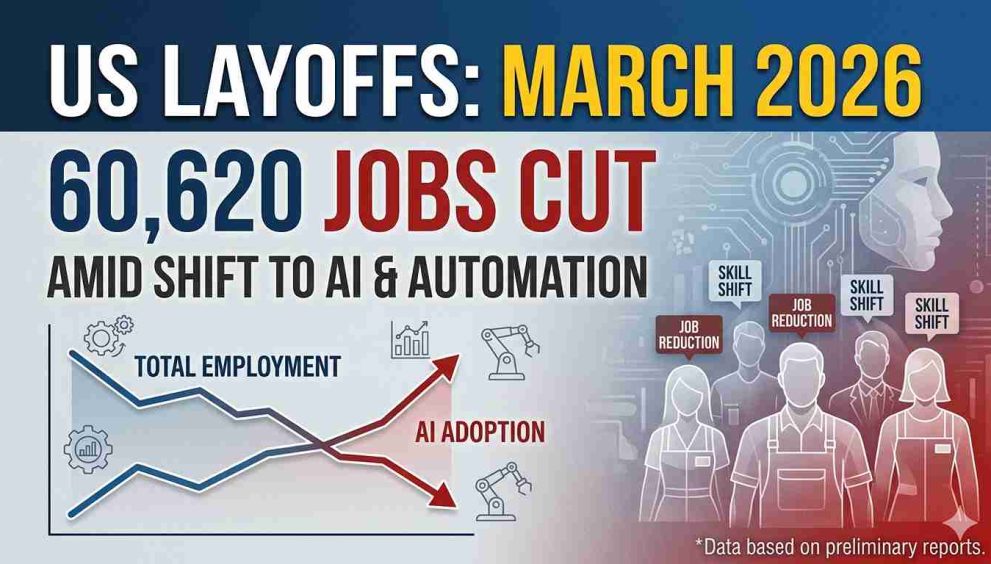
US-based employers announced 60,620 job cuts in March 2026, a 25% increase from February but an 78% decline compared to the massive federal-driven cuts in March 2025, according to the Challenger, Gray & Christmas report.
While US corporate layoffs remain moderated, the technology sector continues to dominate reductions, with 18,720 jobs cut in March alone. Artificial Intelligence (AI) accounted for 25% (15,341 jobs) of the announced cuts as companies worldwide redirect resources toward automation and AI infrastructure.
Globally, the tech industry has seen tens of thousands of additional layoffs in early 2026, pushing the sector’s cumulative total well beyond 70,000–80,000 positions in the first quarter, with major impacts reported in the US, Europe, India, and other tech hubs.
US Country-Wide Layoff Breakdown – March & Q1 2026
- March 2026 total US job cuts: 60,620 (up 25% month-over-month)
- Q1 2026 total: 217,362 – the lowest first-quarter total since 2022
- Top industries affected (Q1 YTD):
- Technology: 52,050 cuts
- Transportation: 32,241 cuts
- Health Care/Products: 23,520 cuts
Key US companies announcing significant cuts in March 2026:
- Oracle: Thousands of global positions eliminated (reports suggest up to 30,000 worldwide impact), with notifications sent at the end of March as the company accelerates AI data center and cloud investments.
- Meta Platforms: Hundreds of roles cut across Reality Labs, recruiting, sales, and core Facebook teams.
- Atlassian: Approximately 1,600 jobs (10% of workforce) to fund AI initiatives and enterprise sales.
- Epic Games: Over 1,000 employees (about 20% of workforce) due to declining Fortnite engagement.
- Other notable US reductions: Ongoing Amazon corporate streamlining, Morgan Stanley (~2,500), Dell, and Block.
AI-driven efficiency, restructuring for cost control, and shifting market priorities remain the primary drivers across American industries.
Federal Job Cuts in the United States
The Trump administration’s Department of Government Efficiency (DOGE) initiatives significantly reduced the US federal civilian workforce in 2025, with approximately 300,000–386,000 separations through buyouts, early retirements, resignations, and targeted reductions in force — representing roughly a 12% shrinkage of the federal workforce.
By March 2026, the pace of large-scale new federal cuts has slowed, though performance-based staffing adjustments and agency streamlining continue in agencies such as Defense, HHS, Treasury, and Veterans Affairs. The overall federal workforce stood at around 2.03 million in early 2026, down from over 2.3 million in late 2024.
Worldwide Perspective on March 2026 Layoffs
While Challenger, Gray & Christmas primarily tracks US-based announcements, global tech layoffs extended far beyond American borders in March 2026:
- Tech sector worldwide estimates for early 2026 exceeded 70,000–80,000 positions cut, with notable activity in Europe (e.g., Ericsson, ASML), India (offshore impacts from US firms), and other regions.
- Companies like Oracle implemented global restructuring affecting multiple countries.
- Additional international cuts appeared in automotive (Volkswagen), manufacturing, and financial services as firms aligned with AI transformation and economic caution.
- AI and automation were frequently cited as factors, with companies reallocating budgets from traditional roles to generative AI, cloud infrastructure, and efficiency tools.
The global pattern reflects a broader shift: organizations are investing heavily in AI while trimming roles that can be automated or outsourced, creating both job displacement and new opportunities in high-skill areas.
Broader Economic Context
Despite elevated layoff announcements, the US labor market showed resilience in March 2026, with steady (though cautious) job additions in non-tech sectors and a relatively stable unemployment rate. Hiring plans slowed in technology and related fields amid uncertainty from geopolitical tensions, AI disruption, and efficiency drives.
Worldwide, central banks and governments are monitoring how AI-driven productivity gains offset workforce reductions, with mixed impacts on consumer spending and economic growth.
Implications for Workers and Industries Globally
- Tech professionals: Demand remains strong for AI/ML, data engineering, and cybersecurity skills, while traditional software, support, and mid-level roles face pressure.
- Federal and public sector employees (US): Continued focus on performance and efficiency may shape future staffing.
- International talent: Multinational firms’ global cuts often affect operations in India, Europe, and Asia, prompting shifts toward upskilling or relocation.
Advice for affected workers:
- Prioritize AI-related training and certifications.
- Build financial buffers and explore visa/relocation options where applicable.
- Leverage networking across global professional communities.
Related Searches:
- March 2026 US layoffs Challenger report
- Global tech layoffs 2026 AI impact
- Oracle Meta Atlassian job cuts worldwide
- US federal workforce reduction 2026 DOGE
- Worldwide job cuts March 2026